About This Interview:
Oral history interview with Cindy Petree, a member of Stillwater’s Sister Cities Council and founding member of the Sister Schools relationship, reflecting on 30 years of cultural exchange with Kameoka, Japan. Topics include the founding of OSU-K, Japanese gardens, trilateral exchanges, and citizen diplomacy.
About Cindy Petree:
Due to her efforts, at the Sister Cities International session in 1989, she and the Stillwater team were recognized for initiating the Sister Schools Program.
Working from President Dwight Eisenhower’s inception of Sister Cities International, Oklahoma established a relationship with Kyoto Prefecture, Japan, in 1985. Eisenhower’s nonprofit organization was established for the purpose of creating and maintaining global connections, and since its origin, the relationships across the globe now number in the thousands. As a result of the Oklahoma-Japan connection in 1985, Stillwater became the sister city of Kameoka. In November of 2015, these sister cities celebrated their thirty-year anniversary.
While the Stillwater-Kameoka relationship was being established, Cindy Petree was not yet involved with the Sister Cities Program but was concurrently working with her Gifted and Talented program at Stillwater Middle School on an exchange project with Alaska. Familiar with how an exchange system works, she approached the Stillwater city delegates who’d been traveling to Kameoka and offered a collection of gifts to be taken to a Kameoka junior high school on their next trip.
That gesture launched the Sister Schools Program, established in 1989. Petree became the program’s coordinator, working on the relationship between Stillwater Middle School and Taisei Junior High School in Kameoka. Due to her efforts, at the Sister Cities International session in 1989, she and the Stillwater team were recognized for initiating the Sister Schools Program. Since the project’s inception, she has been chosen multiple times to represent Stillwater in Japan and has become a member of the Sister Cities Council.
In this interview, Cindy reflects on the enduring legacy of the Stillwater–Kameoka partnership and the human connections that have shaped its story.
Transcript of Oral History Interview with Cindy Petree (2015)
SOK Oral History Project
Interview of CINDY PETREE
09/18/2015 – Stillwater, Oklahoma
BJ: Brandon Jones
CP: Cindy Petree
Brandon Jones: My name is Brandon Neal Jones and today is September 18, 2015. We are here in the library of Stillwater Middle School as part of the spotlighting Oklahoma Oral History series, a part of the Oklahoma Oral History Research program. I will be interviewing Ms. Cindy Petree on the Sister Cities International relationship between Kameoka, Japan and Stillwater, Oklahoma, and more specifically the Sister Schools program. Thank you for joining me today.
Cindy Petree: You’re most welcome.
BJ: So, um, tell us a little bit about how you got started with the Sister Cities program, um, and then we’ll get into the Sister Schools—but let’s start with the beginning.
CP: Actually, the Sister Schools Program came—the, the school connection came before the Sister Cities did…
BJ: Okay.
CP: …uh, the community center here in Stillwater was the old middle school. This became the middle school in 1986 but before that time, we, uh, we started the Sister Cities program, of course, in 1985 as you learned from your other interviews. But there were city officials going back and forth at that time and I was not involved with our program at all at that point but I was teaching the gifted and talented program at the middle school and we had done a big project on the state of Oklahoma. We had gathered all kinds of things—we had done this also in elementary school; gifted programs. I’d been teaching those here in town and then had gone to the middle school program. We had exchanged with a school in Alaska, for example, and gotten some neat things back from them. So, we had done this program and when I found out we had city delegates going to Kameoka to visit with them I asked one of them–I said, ‘Would you take a box of things and give it to a school?’ and they said ‘Sure, we will,’ so we put together—we’d already put together a scrapbook of Stillwater and a scrapbook of Oklahoma…things like, um, our official, um, state song and our bird and all these kinds of things the kids have had to research, and mind you, this was long before the days of computers in schools. So, we used lots of things from the Chamber of Commerce, for example, and the Oklahoma Tourism Bureau and they had put all this together along with things like quail feathers and red dirt and, uh, um, pictures of windmills and just all kinds of things and we sent these things in a shirt-box with one of the officials to be given to a school. While they were in Kameoka, they visited Taisei Junior High School one day and took these things—and the official, later, when he came back, he also had gifts from the school to bring back to us. So he left the box and brought it back and then he spent some time—it was actually Carl Weinaug, who was our former, uh, one of our former city officials—and Carl came and visited with my students to tell them about Taisei. Um, he said that it was so interesting because most of these kids had never seen an American in person before because Kameoka is certainly a bedroom community for Kyoto and it was a situation where, um, they would see television but certainly not ever in person. So, he said they were literally hanging out the windows of the school when he arrived. They had a great visit that day and then brought these—some artwork back for us. Well, of course, that meant that the next time a group went that we had to send things back to them again and then, of course, they sent things back for us and that was the beginning of it. And we did that in 1985. So, between 1985 and 1989, we went back and forth with a number of gifts until the city—the Sister City officials, here in town—because by this time the committee had been formed…the city committee had been formed—and some of our city officials said, ‘You know what, we just need to do this and make a school connection between this,’ so the Sister School program was born in 1989—April of 1989. Again, there were visits back and forth with some school people, um, our school people…our school, uh, students and teachers and even the school district personnel did not travel to Japan, uh, in those first few years but as the city officials went back and forth, they took a number of things with them and so then I got involved through that.
BJ: Okay. So, the… it was the Sister Schools, um, even before it was official that they brought you into the…
CP: Right.
BJ:…into the mix…
CP: Into the mix.
BJ: …okay. Okay. And, um, now has…has your relationship with the Sister Cities Council, um…did you start out with…how do I phrase this…did you immediately begin working with the Sister Cities Council itself or have you—er, did you start out just kind of spear-heading the school project?
CP: I spearheaded the school project because I was the…the one who got us involved in the first place…
BJ: Okay.
CP: …so, part of it was just keeping the momentum going here…
BJ: Mhm.
CP: …and then working out how this Sister School Program was going to look, for example. As our guests would come, like in 1988—1987, 1988—as different people would come and see the school—because they knew that we had made this connection with Taisei, um, I would be the…the…kind of the school spokesperson that would host them here—maybe the host would be a better word for it—and then as I began to get more and more involved with the people in the Sister Cities, um, committee then it became very natural as an opening presented itself to say, ‘Well, come join us on the council,’ and I did and…
BJ: Okay.
CP: …and other than three years where I lived elsewhere, I’ve been a member ever since.
BJ: Been a member ever since. And…so 1989…
CP: Mhm.
BJ: …April of 1989 is the—kind of the official start…
CP: It was.
BJ: …of the exchange…
CP: It was.
BJ: …Um, what was the first event that kind of set that up?
CP: It was huge, Brandon. It was huge. We had, uh, four official documents which were signed by these two schools. The first two documents—actually, all four of these documents were taken to Kameoka and the…the mayor of Kameoka, Mayor Taniguchi, and our mayor, Mayor Anthony, and the school officials, in a very formal ceremony sat down and signed these beautiful documents that had been prepared for this event. So, the school officials signed off on them and then they had this amazing program of music and…and celebration to kick it off. Well, then they came back to Stillwater and in April of 1989, we had our…our same program—we actually mirrored their program. We used their national anthem, our national anthem. They sent their, um, Kameoka flag, the Taisei Junior High School flag came back to us. We’d sent an Oklahoma flag to them, so they used it and then brought it back and we had the very same flags here and then, again, Mayor Taniguchi was here and we signed everything officially here, also. It was a huge event and I’m saying he was here—actually, I don’t remember if he was here or not to tell you the truth…sorry about that. Um, but the—our mayor was here and we signed all the documents here, too. So that was the first big event and it was very, very important to us because it establishes—and to the best of our knowledge, we are the first school ever to become Sister Schools out of a Sister City agreement. There are other schools around the world that have formed Sister School agreements but not…out of Sister City agreements…so it was like a child that was born, you know…
BJ: Mhm.
CP: …from the Sister City agreements. And back in, uh, 1989 at the Sister Cities International event, we were given a special, um, recognition for this program that had
BJ: This…
CP: …that had been, uh, birthed from this.
BJ: And, uh, this in 1989…this would have been one of the international…
CP: This would have been one of the international, yes.
BJ: …is that the right word?
CP: Yes, the International Sister Cities, uh, Conference. And I’m sorry—I don’t remember where that was, actually. I wasn’t there.
BJ: And, um, let’s see here… a name that comes up in some of the interviews that I’ve done is John Mills…
CP: Yes.
BJ: …uh, now, can you tell me a little bit about, um, because I know he was the principal…
CP: Mhm, he was here.
BJ: …of the middle school…
CP: Mhm, yes he was.
BJ: …and what was…now, you kind of spearheaded the project…
CP: I did.
BJ: …how does John Mills fit into this situation? Um, just tell me a little bit about him.
CP: Mr. Mills was our principal.
BJ: Right.
CP: And he was 100 percent behind this program. We’ve had several principals since then and all of our principals—all of our, uh—the principals here, our central office people, the administrators, the superintendent, the assistant superintendents—have all been 100 percent in favor of what we have done here. Um, as much as possible, we have, uh, funded it—uh, Stillwater’s been—the public school district—has been very, very generous through the years to help fund this. But Mr. Mills was instrumental in being the—because…because our Japanese friends are very, um, very aware of the hierarchies. So, Mr. Mills was certainly the most important person—the highest ranking official—that we had in this building then the superintendent was the highest ranking Stillwater official. So, always, um, my job as the…as the Sister School Coordinator—which I was just kind of given that title—um, was several steps below the superintendent and, of course, below the mayor and everyone else. But it let me, um, be the…the communicator back and forth between the two programs as we continued to evolve. You see, Stillwater only had one school of this level. Kameoka had seven at the time.
BJ: Oh, wow.
CP: And we just connected with one…
BJ: Okay.
CP: …so, when we were finally able to visit, we started with Taisei. And Mr. Mills, um, suggested that we put together a delegation to go. So that was in…in 1990, so it would have been the following year. We had a group come…let’s see… a group of students and teachers who came and visited us in 1990 and then we went—they came in the spring and we went in the fall to…to see them. And this was the first time we’d ever taken a student delegation to Japan.
BJ: And this was what year?
CP: 1990.
BJ: And 1990 was…
CP: In the fall of ’90.
BJ: …was the first year you brought students…
CP: Uh-huh. Mhm.
BJ: How many was in that first…?
CP: We took, uh, 12 with us to Japan.
BJ: 12 students?
CP: Uh-huh.
BJ: And how many staff and…?
CP: Uh, four. Four…
BJ: Okay.
CP: …We took our superintendent of schools, Mr. Mills, uh, one of our other teachers, Ms. Marilyn Twicky and I went. And Ms. Twicky just simply—we…we opened the process up to an interview for anybody who wanted to apply and she, uh, applied and was interviewed by some of the Sister City Council people. She was a social studies teacher here. I still had the gifted program at that time and the four of us went to Japan and did a lot of official things to…to really be the ceremonial beginning there just like they had been here. And again, when their group came in the spring of 1990, we did all the official things here. Of course, the things we do are much more…I would say…casual than the things they do. For example, we’ll go horseback riding and take them on a cookout and eat barbecue, you know, the kinds of things we do in Oklahoma. Um, in Kameoka, we do more formal-type events. So we were ready for that but we had a wonderful time connecting with student groups, connecting with the teachers at Taisei, uh, we visited city hall—we were so, so, so well received. We had—our students applied and interviewed for this—and we took, uh, five 6th-graders, we took five 7th-graders, and two 8th-graders because the 8th-graders had been a part of this when we became Sister Schools.
BJ: Okay.
CP: So, we wanted to have a connection that followed, you know, that followed that process on up. We had to interview some 5th-graders because we knew they would become 6th-graders so we had to involve them early because they were going to enter the school in August and we were going to go around the end of October. So we had to…we had to get them involved and get them up to speed a little bit.
BJ: And how long of a trip?
CP: It was about eight days long.
BJ: Eight days.
CP: Yeah, it was a wonderful trip. We spent a lot of time in…in what we would call Sunday clothes. Lots of…lots of formal times. But we also taught the kids how to play Red Rover…
BJ: Okay.
CP: …and we taught them, um, hacky sack and we had just a great time. One of our students was…was very blonde…
BJ: Mhm.
CP: …and our Taisei counterparts—our kids—were very interested in touching her hair because they had never seen, uh, someone who was blonde. One of our students—in fact, she was the daughter of one of our former mayors, Roger McMillan’s daughter—um, had curly red hair and the girls all wanted to touch her hair. One of our students was Taryn Sanderson, who’s African-American, who ended up being one of our high school football stars and, uh, went to the air—to, uh, one of the military academies and is a…has been a wonderful role model, um, for a lot of young men. Because of his darker skin, these kids at Taisei had never seen an African-American in person, and bless his heart, he would just put his arm out because all the boys wanted to touch his arm. But our kids were so…great with the…with the Japanese kids and it was so awesome to…to look and see several of them sitting down and just laughing. They couldn’t speak each other’s languages but they always found something to laugh about. And they taught our kids how to do calligraphy and how to play games and, um…they just had so much fun together. We took them to a camp up in the mountains for an overnight trip and they did everything from, um, oh my goodness, all kinds of games to a tea ceremony to flower arranging and the moms came and cooked for us and it was just a magical, magical time. So, it was the kind of thing you could never plan it would go that well but it was laying the foundation stones for the kinds of things that would be done in succeeding years when their kids came here and when our kids went there. And we started doing yearly exchanges. We would send a—we decided with the Kameoka official that we would send a teacher and two kids in the fall and they would send a teacher and two kids in the spring. So, that’s what we did and the…and the trips were usually about 8-10 days long…something like that. Usually, you know, a little bit more than a week to travel and have about a week at the school. And they would come and present classes on Japanese culture, um, Japanese language study—they would teach the kids how to play games and we would do the same thing. So we…we did all kinds of art activities together. We made quilts together where we would do quilt squares and they would do quilt squares and we would put them together. We, um, would take pottery from here in town with our natural red dirt and they would give us pottery, um, the daruma—I wanted to tell you about this—was one of the first gifts they ever gave us. The daruma is an old legend in Japan and our very first visit to Taisei, in the formal welcome ceremony, they had the daruma there but the daruma had no eyes. And so…so what we did—Mr. Mills as the…as the principal of the school painted in one eye because the principal said that it was their wish to visit our—their school in Oklahoma. So, they sent this—the daruma home with only one eye painted in and you can see that the eyes are not exactly equal so when they came for their celebration, they painted in the other eye. So, the daruma has been a very, very, very special gift to us because it…it traveled all the way from Japan in…in its box with one eye and then spent from October to the next April in the case with one eye waiting for the Japanese students to come and…and finish the dream.
BJ: And finish…
CP: So, and this has been our symbol of the dream that we had to begin to introduce our kids to Japan and what we would do—we would also set up pen pals.
BJ: Mhm.
CP: And, again, this day in time, we had no, um…there…there was no email back and forth. So as we traveled back and forth, we would take letters from our kids to their kids and the kids would put things in it like—they would put little tiny origami figures in and we would put, um, coins and postage stamps in ours so the kids would have like a penny—a new penny or something. And sometimes the kids would bring a picture or our girls would put in a little hair bow or—you know, they would always find—boys would put baseball cards in and they would send these to their pen pals and then we’d have another group. We decided at one time, as best we could figure, we had probably 70 percent of all of our kids who ever went through here in an ongoing, uh, pen pal program with our kids in Kameoka. And we’ve actually had kids who’ve started pen pal programs as elementary kids and carried them on until they were adults. And we have those connections still in Stillwater. It’s been a magnificent experience for the kids of Stillwater schools.
BJ: It sure sounds like it.
CP: It has been.
BJ: I kind of wonder, you know, a program like this growing up…it…it just sounds amazing.
CP: And Japan was always a country that was on the other side of the world. Again, in the days before the internet our kids were not knowledgeable about what was going on in worlds other than theirs, I mean, we had—certainly, we had television, certainly, we had encyclopedias and things like—we had…we had print media but we didn’t have this instant access so everything they had…for…for, for them to come and be in our school and to arrive in uniforms—because they wear uniforms—and then to wear, you know, sweatshirts and jeans and…and do things with us here…and then have to put the uniforms back on the last morning they were here, our kids would see that and our kids would…would—they would follow them out the front door telling them goodbye. The Japanese kids would weep as they leave because they made friends here and it makes me tear up to think about that. Our kids, when they went to Japan, would weep when they left their host families because their host families had adopted them. As a…as an adult taking my kids to Japan—I traveled with the big delegation but I also traveled later with a student delegation—the hardest thing I ever did was to watch those two little girls get in an automobile and leave my sight and go stay with people I didn’t know in homes that I didn’t know where they were. It didn’t matter that I was also going to do that but my little girls were headed off somewhere. But when they came to school the next morning, they were like, ‘Ms. Petree! Ms. Petree! We did all these things,’ and I had things to tell them. But, you know, when those kids came here, we had also very much vetted our families to make sure they were in safe places with kids from our school and families we had met and visited with and I had to watch that teacher send his kids or her kids home with my host families, too. So, we involved so many families and so many, um, businesses and organizations in town to help us be able to reciprocate the kind of hospitality that we had there. It was different because this is Oklahoma.
BJ: Well, and, uh, I wanted to ask you about…because you mentioned the language barrier…
CP: Yeah. Yeah.
BJ: …but, obviously, these kids are…are…are forming relationships…
CP: They are.
BJ: …they are forming bonds…
CP: They are.
BJ: …so, how…do you have a way of explaining how the com—how they get past the language barrier?
CP: Yes. One of the things I personally did was to go to Meridian and take a course in Japanese.
BJ: Okay.
So, we’re sitting at the table and her daughter who was a…a, um…she was a, um, university student, had come in for dinner and we were just visiting and visiting with her and, um, she picked up the photo—the daughter picked up the photo album and she was flipping through it and she got to the picture of me at Taisei and she said, ‘I have this picture in my yearbook!’ So, she went upstairs and got her yearbook. She was a student at Taisei when we were there for the very first time. And it was in the…the visit was in her student yearbook.
Cindy Petree
CP: So, I learned the pleasantries—I’m going to say that—how to introduce yourself. Uh, the words to use to say, uh, ‘My name is,’ how to say ‘please’ and ‘thank you,’ how to say…how to say ‘This food was delicious,’ how to say, um, ‘Good morning, ‘Good night,’ ‘How are you?’ Just the pleasantries. Students in Japan are required to take English. But we call it “the book is on the table” English because it’s not useful English in…in their words, not in mine. So, when our students would come over, they would love to practice their English with our students.
BJ: Okay.
CP: And they would teach our kids how to say more things and they would teach them the right things…
BJ: Okay.
CP: …in the same way we told our kids, ‘Now, teach them the right things when you teach them English.’ Their teachers wanted our kids to write them in English because it would be a way for them to practice.
BJ: Okay.
CP: But we would also give our host families, um, information sheets that would have some basic things like, um, ‘Please call my teacher,’ you know, so in case they did feel bad or got sick or something they would know how to get in touch with us. So, we had those little pleasantries. I’ll tell you a funny story because one of the things that we taught them how to say was, uh, ‘Where’s the bathroom?’ So, I had my two little girls in the car with me one day and we were with one of the city officials and the girls had their cards—they had, um, index cards—and we had OSU people who helped them translate. At first, we would do all of our speeches in English when we would go to the schools but then we started doing them in Japanese and we would have Japanese students at OSU who would translate—the girls or the boys would write out their…their ‘Thank you for inviting us. We’re glad to be here,’—their two or three minute speeches in English and then they would be translated and then we would practice the Japanese before they went. But the girls were sitting in the backseat and they were practicing their speeches and they were practicing their phrases and they got to the one of, ‘Where’s the bathroom?’ and they got tickled because it was…it’s kind of a funny phrase. And so they kept saying it over and over again and laughing and I knew what they were saying but the city official was very concerned because he was afraid that he…we needed to make a stop for the girls and I was like, ‘No, no, no, no. They’re just practicing.’
BJ: (laughter)
CP: But we all, um…we all worked together…and…and, you know, it’s a cliché but a smile really does go a long way and when we are trying to communicate, um, we use sign language, we do…we use a little bit of everything to get across those basic things. But I’ll tell you, I sat in the teacher’s room at the school and was heartbroken because there were so many things as teacher-to-teacher I wish I could’ve talked about. And I did not have the language to do that. I couldn’t talk about my classes. I couldn’t talk about, um, just…just the…the things that teachers all talk about when they sit down together and I knew that the teacher on the other side of the table from me had had the very same classroom experiences as I had but neither one of us had the language to talk about it. We just had the most basic language and a couple of dictionaries, but other than that, you know, again, we didn’t have the electronic translators. We just had the dictionary and my…that has always been my desire was to really, really, really be able to talk. And sometimes with translators we could. But that was, to me, the hard part. That there were so many things we had to leave unsaid because neither one of us knew the heart language of the other…
BJ: Yeah.
CP: …you know?
BJ: Um, so, we’re doing the…the—Stillwater’s sending students over in the fall and Kameoka is sending students over in the spring and…
CP: Was.
BJ: …was…
CP: Was. Okay. Uh, in 9/11, when 9/11 occurred, we actually were preparing a teacher and two kids to go. They had been selected in the spring and we’d been working all year to do that—oh, all summer, sorry—all summer to do that. Uh, and I literally was within a week of purchasing their airfare using—the school provided their airfare—and we were within a week of purchasing the airfare when 9/11 happened. Not knowing what would happen next and, of course, thankfully, thank God nothing did happen but no one knew that at the time.
BJ: Yeah.
CP: It was…um…very natural that no one was going to send a child halfway around the world. So, we made the difficult decision that we had to not go that fall. The school to which we were going sent us the ultimate gift they could’ve sent, which was a hanging of a thousand paper cranes, which is the ultimate gift of peace. And expressed their…their sympathies to us as a school that we couldn’t come, as a nation for what had happened, and expressed their, um…their heartfelt ties to us through this. For many years, it actually hung in the office. It’s now in the showcase here in the school where we have many of our gifts. But that was…that was our connection until the next year. So, we had to wait a year. The next year, because we wanted to continue the project, we let two more students apply to go. So, we actually sent the same teacher, the same two kids who were now 8th-graders—not in our building anymore—and two 7th-graders. So, we sent the teacher and four students that year. Then in the spring, of—what would that be?—that would be…it was 2003…we then brought a teacher and four students over that year for the first time. We continued to do this ‘til about 2007, ah, roughly 2007. And the United States and Japan were both having major economic issues and I had visited—I had gone for a week for a special, uh…we had had an adult delegation that went for a special celebration and as we sat down with school officials, um, Larry Jones and I sat down with the superintendent and other city officials and we decided, at that time, that, honestly, neither school district could afford the face-to-face visits. So, we had to agree…we just decided right then that it was going to be a hiatus, uh, that we would keep the, uh…uh, the Sister School relationship going but neither…neither school district had the money to send people anymore. Their school district provided their airfare and all the gifts that were part of the exchange, um, a few hotel stays, um, when they were here, a few meals. When they would come, we would pick up everything they would do with us, okay? So, the cost was…was large. It was between—with airfare and everything—it was between $5,000-$10,000 a year to do this. And our district had said, ‘We’ll do what we can do,’ but, honestly, we did not ask parents to pay for their airfare because we did not want any child to be eliminated from this. Um, we had other cities like Shawnee that would send huge numbers to places, um, they would send like 30 kids, but they had industries that could help them, they had other organizations that could help them. We didn’t have that kind of a…of a support base…
BJ: Mhm.
CP: …but the city had done…the city and school district had done everything we could do at that point. Um, there has been a…we’ve had a bit of an uphill battle since then just because it was easier when we were face to face to keep the momentum going.
BJ: Yes.
CP: But we’re looking at many ways to do it. We have a…a 14-15 hour time difference so it’s very hard to sit down and Skype.
BJ: Mhm.
CP: Or to Facetime or…or something like that. Um, we have done several, uh, pen pal exchanges. They have not been whole exchanges but we are hoping this year, with the big anniversary, that there will be a revitalization of what we’re doing. Uh, but we’ve actually been Sister Schools for 26 years. It’s been a long time.
BJ: And always with, uh, Taisei?
CP: No. We…we’re Sister Schools with Taisei. But we as—and that’s a good question—in the time of our visits, we’ve actually visited all of the junior highs so that everyone was able to participate. But part of every visit was sometime at Taisei…
BJ: Okay.
CP: …even if the majority of the visit was at Nansō or Tōki or, um, Takada or whatever the school was we always, always, always went to Taisei. And we always kept the connection there. And it has been—I’ll tell you an interesting story—my last visit when I was there, which was about…I’m thinking, oh, I don’t know…six years ago, maybe? Um, I was staying with a lady who had volunteered to be a homestay and I had a little photo album of myself and my…my, um, my home here in Stillwater, my school, uh, my siblings, you know, just…just some Stillwater things…but I had a picture in there of when I visited Taisei for the first time. So, we’re sitting at the table and her daughter who was a…a, um…she was a, um, university student, had come in for dinner and we were just visiting and visiting with her and, um, she picked up the photo—the daughter picked up the photo album and she was flipping through it and she got to the picture of me at Taisei and she said, ‘I have this picture in my yearbook!’ So, she went upstairs and got her yearbook. She was a student at Taisei when we were there for the very first time. And it was in the…the visit was in her student yearbook. She brought it down and it was the exact same picture that I had that she was there. The lady did not remember. The…the daughter did not remember but there was a connection with this lady who had known about the school exchange for many years, her daughter had been a part of the program, and here she was just offering a homestay visit to a Stillwater person. She has since visited Stillwater, has been in my home, has visited here at the school, and has seen my—has…has met my students, too, so there’s so many of those connections that have, um, come and gone. Another time, I, um, was visiting a doctor here in town and he walked into, um, the room and he greeted me in Japanese and his nurse looked at him and I answered him back in Japanese. He had been one of the students who traveled with us and now was a medical doctor here in Stillwater. So many ties. So many ties here. Um, we’ve had teachers whose kids have gone. We’ve had kids who’ve gone whose parents have visited there. We’ve had kids who’ve visited who’ve kept students from Japan and other visits. So there have been…it, it is truly a multi-generational, um, program.
BJ: And what…what are you doing currently with the program and the students? What are some of—because, now, you did say that the time difference makes it a little difficult…
CP: It makes it difficult.
BJ: Um, so, what kind of projects have you found?
CP: One thing that we did last year was to start a Japan club, um, as a way to re-introduce our kids here, this generation really, uh, of kids to the school program—the Sister Cities program and the Sister School program. We still have three teachers—two others besides…besides me here in the building who have traveled to Japan, so, we…we did things last year and we just kicked it off last year. We did things like, uh, some anime with them because that’s what they were interested in. We did some Japanese language, they learned about the Sister School program, they helped us, uh, we have, uh, one of our…our travelers, uh, built us a Japanese garden as his Eagle Scout program so we—they helped us clean the garden up and they did a number of things. This year, our…our…this—we’re still in the early days of school and we have yet to formally start this program but because we have the delegation coming to the school, that’s the way were going to kick off the Japan club this year is we’re going to get them involved quickly with the visit.
BJ: Okay.
CP: To, to make the welcome displays, to get the showcase of gifts that…that have been exchanged ready, to get the garden prepared, to be host and hostesses when they come to our school that day. So, this is how we’re going to do it.
BJ: Okay. And…now you told me you’ve got a…you have a Japanese garden?
CP: We do have a Japanese garden…
BJ: You do?
CP: …in front of the school. Mhm. We do.
BJ: And, um, we’ll have to take a look…
CP: We will.
BJ: …when we’re done interviewing. And…really not sure…now, this all kind of grew out of you being in the Gifted and Talented program…
CP: Guilty as charged.
BJ: …yes. Is that a…is there, um…is this program still under some sort of a…uh…of, of…
CP: Guidance?
BJ: …of, of, of, of, of, uh, the gifted and talented program? Is this—or are you fully moving this into this Japan club? Uh, is there a connection there between you and the two other teachers?
CP: That’s a great question. That’s a great question. Um, our current Gifted and Talented program—I taught that for a number of years here in Stillwater and as long as I was doing it, of course, we did that. But when we had the school visits, all of our kids were involved, every single child was involved. Every single child would…would be a part of the visits. And they—the kids would tell us—our Japanese visitors would tell us what classrooms they wanted to visit. Sometimes they went to orchestra, they would go to…to math, they would visit science and do experiments, they did—they would go to Spanish class. They did everything so every child was involved. Nowadays, um, I teach World Studies and the emphasis and indeed the state standards for 7th grade World Studies, or 7th grade Social Studies, is the Eastern Hemisphere. So, a study of Japan is a very natural part of our 7th grade Social Studies. Um, this year, of course, with our…with our delegation coming, we don’t actually study it in our…in our curriculum until the spring but we’ve got a wonderful tie-in this—this fall with our visitors and with our, um, time when they will be here. And with, of course, our OSU students, um, there are times—um, sometimes, more than others, they’re involved, um, with things going on in the district. Things, you know, we involve them as much as we can, not ever as much as we want to. We always wish they could do more with us. But all of our 7th graders participate in the study of Japan so definitely, this year, um, awareness of this program will be part of what we’re doing. So, I—I’m looking at this as a way to—and I used this word earlier—to revitalize. You know, what we wanted to do and we’ve got a natural reason to do this this year. And we keep our teachers involved with this and they’ll be involved with helping us get ready, uh, for the…for the visiting delegates who will be coming in October.
BJ: Yeah, for…
CP: Which is exciting!
BJ: …the 30th Anniversary…
CP: It’s exciting! I know…
BJ: Um, why don’t you tell me a little bit about the object…
CP: Okay.
BJ: …that you have here. Do you…?
CP: Uh, no, one of our…our favorite people to visit when we go to Kameoka is…is Mr. Nishijima. Mr. Nishijima is a very, very, very well-known potter in the region. And one of the times that I was there with my…my two…two, um, delegates, um, my students, we actually went to Mr. Nishi—Mr. Nishijima’s house and tried some pottery. It was not very pretty on my part, I must say. My girls did much better than me. Though, he fired them and sent them home for us but one of the gifts that was given us, and the inscription is on the bottom, um, it was a PTA gift from, and…and…they…they bought it locally from Mr. Nishijima and they—some PTA delegates came and gave this gift to us in 1992. And so this is a very, very prized object because we know Mr. Nishijima and he’s important in…in—to all of us in the Sister, uh, Cities program.
BJ: He…he’s…
CP: And…he…he…
BJ: …he’s a sculptor in Kameoka?
CP: He…he…he is a potter and a sculptor in Kameoka and has been part of the program and many of his gifts have come to America and then many of our local potters have sent gifts—we had, uh—there’s been, uh… a Red Earth pottery for many years and we took things like Frankoma pottery but we took many, many Red Earth pottery gifts, we’ve used local weavers and we’ve taken everything from, uh, dreamcatchers to baskets of all kinds and we…we always took gifts for homestay families that were very, um, typical of Oklahoma. We’ve taken lots and lots and lots of rose rocks to Oklahoma over the years because they’re so fascinating and unique. Uh, but we’ve taken like…things like bolo ties, we’ve taken step—uh, uh, sorry—strips of, um, sets of, of, US, um, postal stamps.
BJ: Mhm.
CP: We’ve taken road maps, we’ve taken artwork. I love to buy gifts at things like the Spring Arts festival because we’ve taken photographs of Oklahoma scenery and paintings of Oklahoma birds. Anything we can find that shows them our beautiful state. We’ve taken books and calendars and just all kinds of amazing, amazing gifts. Uh, and then the kinds of gifts they give us have been very typical. When we would go to the schools we would have a gift for every child.
BJ: Okay.
CP: And it was usually a small, um, brochure that would have some students name and address plus, always, a coin and a stamp. They would do the same thing for us and bring us something from every single child and we had more children than they did in our school…
BJ: That’s what I was just about to ask you…
CP: So some of their kids had to do a number of these very small pen pal cards.
BJ: If you had to estimate, um, about how many children are in the, the, uh, Taisei?
CP: Their school? At the time we were exchanging, we had about 700.
BJ: Mhm.
CP: And they had about 400.
BJ: Okay.
CP: Now, we have almost a thousand and I don’t know how many they have quite honestly. But we will send some things back—one of the things we love to send teachers were bandanas because they…because they have the Furoshiki, the…the cloth that they would use to carry, um, their lunch to school in many times and they would…they would wrap their lunch box up and tie it up and then put their chopsticks in it. And it would be a beautiful piece of silk and these could be used then when they…when they were ready to sit down and eat. They would open their lunch box and the Furoshiki would become their…like their tablecloth. Well, our bandana was the best we could do but they loved our Oklahoma, um, the prints that we would buy and…their…their obviously not made here because it’s very difficult to find things like bandanas that are made in Oklahoma but we explained to them that that’s part of our economy. That a lot of our things come from Asia. But, they…the bandanas would be in Western prints and they just loved those. So, we would send things like that…we would send them a lot of dreamcatchers, small dreamcatchers. Or any kind of wheat weaving and…and…and I, quite honestly, it’s been a several years since we send…since we sent it but there were no restrictions on things like wheat weavings and artwork and things like this. But we will be preparing something to send back to Taisei. We sent a lot of yearbooks back and forth, too. Just to let them know that, um, we are here and we are still a part of…of what they’re doing. But I want to show you this because this is one of my most special gifts that has ever come from, um, Taisei. This is a special kind of rock and we may need to put it where the camera can really pick it up but in the mountains around Kameoka—um, Kameoka actually means Turtle Hill and there are hills all around—these are beautiful hills—and then in the…in the valleys around it are many, many rice fields.
BJ: Mhm.
CP: So, in the fall when we go, it’s a time for, um, the harvesting of the rice and the…the trees have turned—it’s a beautiful area. But in the hills around Kameoka, there are these very small stones called sakura ishi, which means cherry blossom rock. But these little tiny stones, which, of course, you can see are smaller than a fingernail, uh, your little fingernail, actually look like little rose…lit—little cherry blossom, um, petals. So, the city of Kameoka will not let people take more than three of these stones outside of the city of Kameoka. They’re very, very precious, they’re very hard to find. But one year, um, when I was there the teachers at the school go the city’s permission to take a Saturday hike up into the mountains and look for these stones and the teachers went, gathered enough stones then for the art teacher to take this piece of silk and paint it and if you look closely you can see that they’ve actually painted cherry blossoms on the—you can see, you can see the white through some of this…
BJ: Mhm.
CP: They painted it as a cherry blossom tree first of all then they took the…the wood of the…the cherry blossom tree and the…the little tiny, um, sticks from the cherry blossom tree and put these, um, as the…the wood of this cherry blossom tree. The rocks at the bottom are actually the rocks that the cherry blossom stones are found in and you can see if you look closely they are cherry blossom stones. And then they used this to make us this gift. And they told us that this is a one of a kind gift, there’s never been one made like it, and this was done with special permission from the…the city of Kameoka to the teachers and the administrators of Takada junior high school and it was actually presented to us in 1999. And we had this information that when it’s on display here in our building that the cherry blossom tree, um, stays with this. And our middle school would like to offer this to the Sheerar center as part of our display for the 30th anniversary of the city of Kameoka and the city of Stillwater…
BJ: That’s going to be…
CP: …because it’s so indicative of who we are. Because it’s so unique and so special so we’re very excited to see this…
BJ: Well, I find it very interesting that the connection…or at least the connection that I’m making in my mind between our…our rose rocks here in Oklahoma…
CP: Mhm.
The wise men [were] once asked, ‘Who is my neighbor?’ and the wise men said, ‘The one who shows kindness … to someone else.’
Cindy Petree
BJ: …and Kameoka has a very similar kind of…
CP: It does.
BJ: …geological…(no this is wonderful??) and let’s just…just make sure that I haven’t missed anything here, um, I know that we’ve covered a lot and…I guess let’s talk a little bit about your work with the Sister City Council…
CP: Okay.
BJ: …because you got started with that, now, and I know after the…
CP: Mhm.
BJ: …the Sister School Project, uh, what brought you in to the…uh…uh…I guess it’s kind of a natural thing to flow into the Sister Cities Council…
CP: It was. It was.
BJ: …but tell me a little bit about that.
CP: It has been a tremendously rewarding experience. I met people I would never have met in this city. Um, it’s been wonderful to be on a mayoral appointed committee, um, I think it’s been a lovely way to serve the City of Stillwater because this is home to me. I wasn’t raised here. Um, my father was in the ministry so I was actually raised many places. But this has been my home, in fact, I’ve been a teacher here in Stillwater schools for more than…for over 30 years and this is just one of the ways that I have been able to, I’m going to say, serve my city, to engage myself with the City of Stillwater. Um, I’ve seen groups come and go, I’ve seen delegations come and go, I’ve seen students grow up and become parents in their own right, I’ve seen, um, our wonderful storyteller come from many, many, many, many years and come to our school and, um, spend time with us and, bless her heart, grow old with us. But she has…she has watched a generation also—Mrs.….Mrs., um, Fujita—has been with us for many years. And she was a part of Sister Pro—our Sister Schools and our Sister City program. Um, our elementary schools, two of our elementary schools have formed friendship schools with schools in um…um…Jap—Kameoka—also. We’ve had students who were here who have moved on up to the junior high—to the high school—who’ve been the youth delegate on our Sister Cities Council but what we’ve seen through the years is people who have joined us as what we call the Tomodachi Club, who, Sylvia or Larry may have told you about, but these are people who have been involved in our program. Perhaps they have…they’ve helped us with the gardens, perhaps they’ve helped us with homestays, perhaps they’ve helped us with, um, finances to help fund one of these programs but what I’ve seen is a tremendous support base in Stillwater and I don’t know if, if you’ve heard this story before but, um, when the gardeners were here building the…the garden downtown, uh, we had a gentleman who called city hall and said, ‘I would like to take the gardeners to an OSU football game.’ Did you hear that story?
BJ: I’ve heard a little bit about that…
CP: Okay.
BJ: …but tell me.
CP: He called the—our assistant city manager and he said ‘I would-I would like to take the gardeners to a football game’ and, you know, their time is very full and, you know, and he said ‘No, no, you don’t understand.’ He said ‘I’ve had hard feelings toward Japan since World War 2’ and he said ‘and every day, I’ve driven by and I’ve watched the gardeners give—build and give this gift to the city of Japan and I need to do something. To be a part.’ So he paid for tickets for all of the gardeners to go to an OSU football game. Brandon, it’s these kind of things that have happened…
BJ: Yeah.
CP: …When I was in Japan, I was at a dinner with my homestay teacher and her husband and her parents and her parent—her father—said to me—he…he was asking me questions and did not speak English and she was translating and he…he asked me a question and…and she said in English, ‘Father, I don’t want to…I don’t want to ask her that,’ and he insisted and she apologized and she said, ‘My father wants to know what you think about World War 2?’ and then she apologized again and I…I smiled and I said to him, ‘My father fought in the Pacific in World War 2,’ and I said, ‘It’s possible…that your relatives and my father may have been close together but on opposite sides,’ and I said, ‘I’m so thankful for programs like this where you and I can sit down across the table from each other and become friends,’ and he just looked at me for the longest time and then he nodded. And I thought, ‘You know what? If that’s what it took to break a barrier this program has done what President Eisenhower wanted in the first place,’ which was to bring people to the table and sit down so they—so that former enemies could become friends so that hopefully, we would never again see a war like World War 2 or like World War 1. And I think, as part of the Sister Cities, my little tiny…contribution that I have been able to make to the history of Stillwater and to the people of Stillwater is worth it. If…if I have children who’ve grown up with, um, with good feelings because of the things that they experienced here in this building and have learned about Japan and have good feelings and good attitudes toward, not only Japanese people but through travel, through engagement with other people, through realizing that, um, this world is a lot bigger than they know about and now with our children who are so electronically connected to the world that they realize that the kids on the other side are just like them. They have the same desires and the same wishes and the same hopes for the future and…the same desire to collect stones and give a gift.
BJ: Uh, we have about, I think, 6,000 miles between here…
CP: About 6,000 miles.
BJ: …and Kameoka, yet, um, even with all that distance, uh, there’s way more similarity than…
CP: Yes.
BJ: …than there is difference…
CP: Yes.
BJ: …and especially when you sit down and just…just talk. Communicate with each other.
CP: I…I…when people ask me about this program, I say to them, ‘The wise men once said, ‘Who is my neighbor?’’ Oh, sorry. The wise men was once asked, ‘Who is my neighbor?’ and the wise men said, ‘The one who shows kindness…to someone else.’
BJ: Very nice.
CP: And I think when we…when we, when we hear that parable, and we think about showing kindness to someone else then the people of Japan—the people of Kameoka—become our neighbors. And our neighbors become our friends. And our friends become our family. And I think, to me, that’s what this is all about. That our kids, even though they can connect now in seconds with people 6,000 miles away, when we can bring them face to face, however we do it, they become friends and then they become family. And I think that’s why I want to stay with this. That’s why I do it, actually.
BJ: Well, then this, uh…the 30th anniversary we have coming up, uh, well, um, the delegation comes October…
CP: Uh-huh.
BJ: …the weekend of October 25…
CP: Uh-huh.
BJ: …Um, the actual anniversary is November 3…
CP: Right. Right.
BJ: …Um, and what a better time…
CP: That’s right.
BJ: …other than the 30th anniversary to get this all started…
CP: Yes.
BJ: …and re-invigorate…
CP: Yes.
BJ: …re-vitalize…
CP: We’re eager to welcome them to our building that day.
BJ: This will be. This will be a lot of fun.
CP: It’ll be great.
BJ: Um, I thank you Ms. Petree for sitting down…
CP: You’re welcome.
BJ: …and, and, and, uh…
CP: You’re most welcome.
BJ: …doing the Oral History Research Pro—or…Oral History Research Project with us. And, um…is there anything else you’d like to add? Did we miss anything that, you know, you really would like to get in there or…?
CP: I don’t think so.
BJ: Okay. Thank you…
CP: Thank you very, very much.
BJ: …very much.
——————————END OF INTERVIEW——————————
To learn more about Sister Cities initiatives around the world click here.
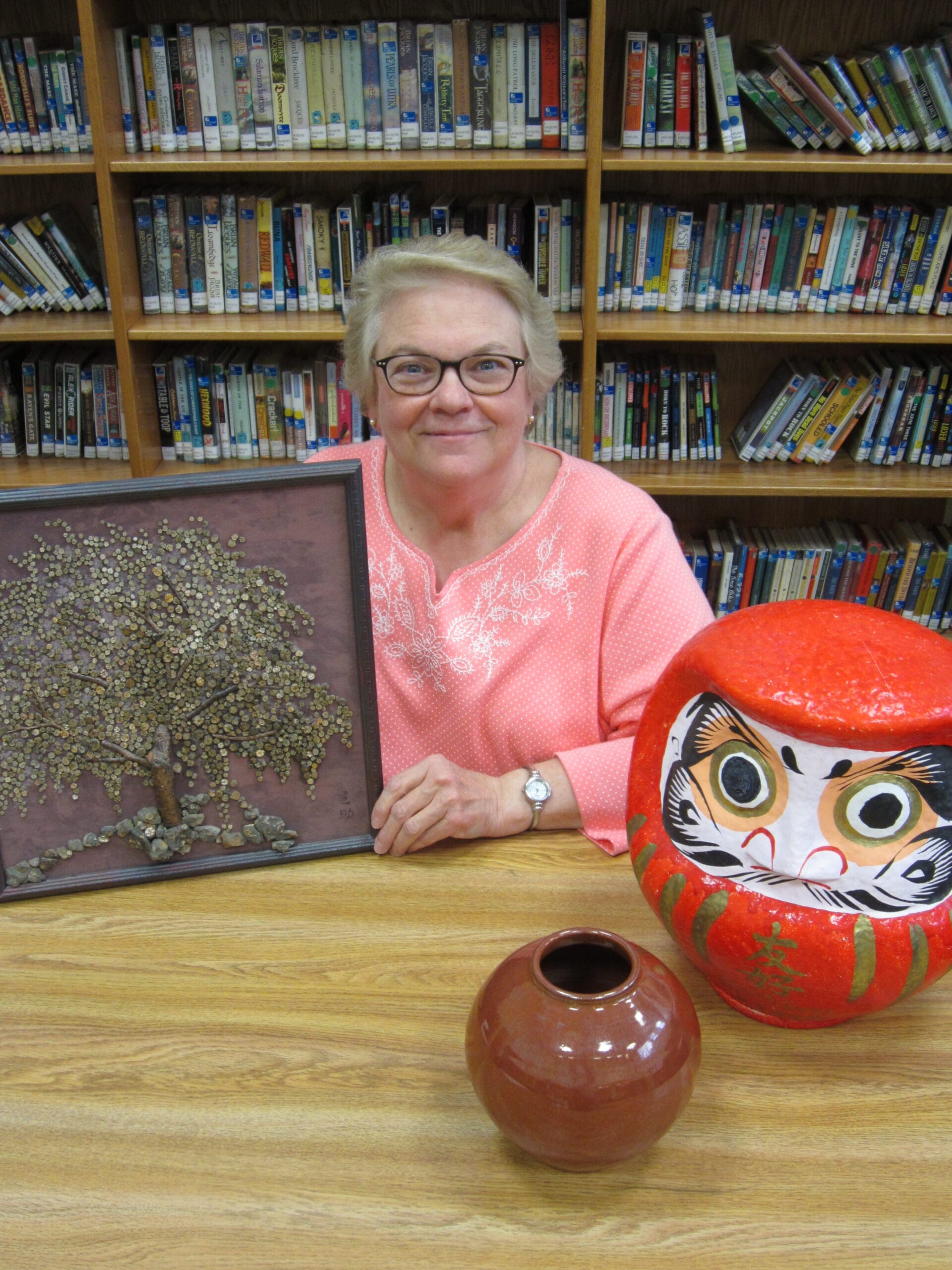
Objects in the Photo with Cindy Petree:
- Daruma Doll (達磨 / だるま) –
This is the large red papier-mâché figure with the wide eyes. It’s a traditional Japanese symbol of perseverance and good luck. Often, one eye is filled in when a goal is set, and the other is filled in when the goal is achieved. - Sakura Stone Artwork –
The framed tree made from sakura ishi (桜石, “cherry blossom stones”) is extraordinarily rare. These naturally occurring mineral crystals form in geometric patterns resembling cherry blossoms and are typically considered national treasures in Japan. Requiring government approval for its exportation, this is a remarkable artifact. - Ceramic Vessel –
The small reddish-brown pot appears to be a traditional Japanese tsubo (壺), a general term for a jar or storage vessel.