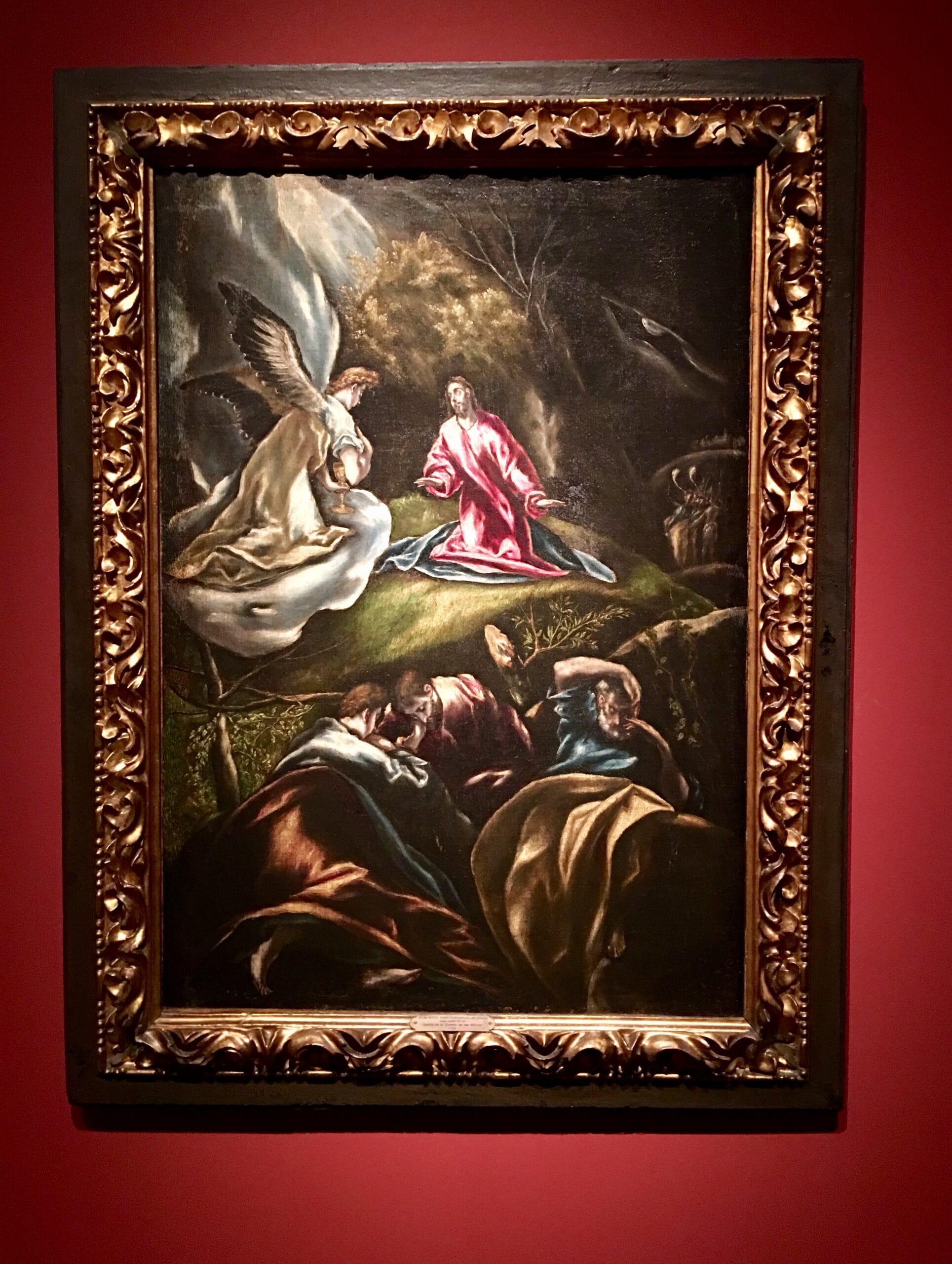
The Vasari Effect and Its Effect on El Greco
Fashion often shapes art history. Trends turn myopic: El Greco’s story makes the point. This essay recenters El Greco’s Cretan years as the foundation of his so-called ‘mature’ style. From his death in 1614 until the early twentieth century, most writers largely forgot him.[1][2] The artist better known as “El Greco” mastered his craft in Crete before he ever left for mainland Europe, yet art historians still label his later works as his mature works.[3]
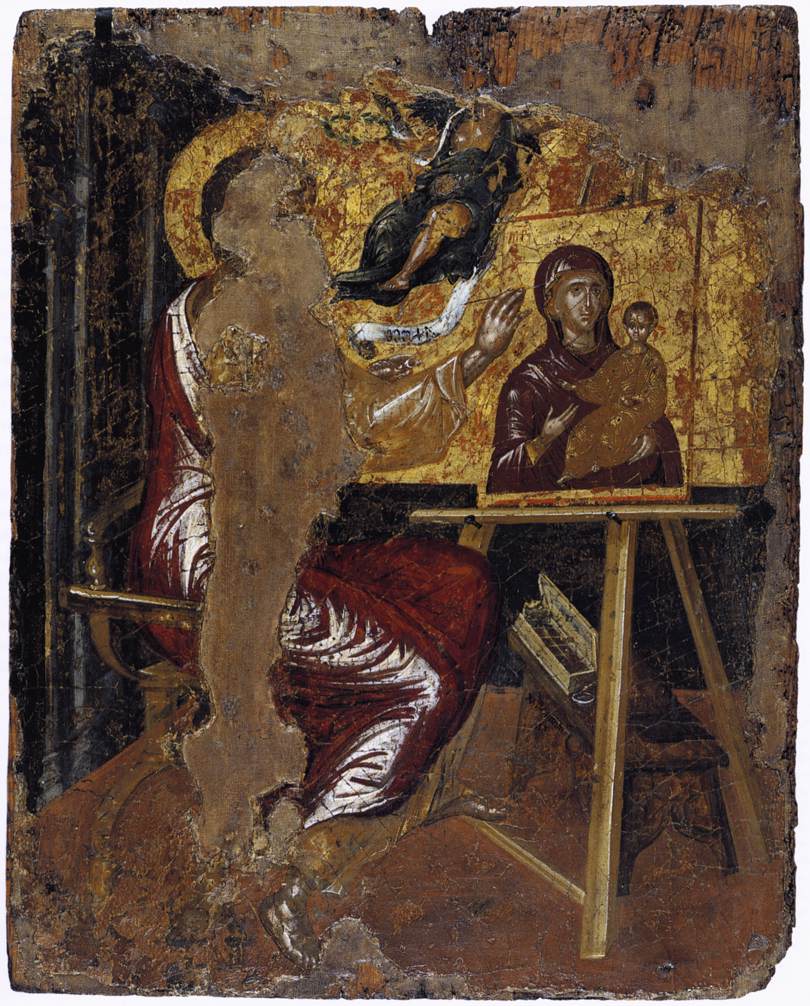
Doménikos Theotókopoulos was a painter of Byzantine religious icons. We have two firmly attributed examples from this period. St. Luke Painting the Virgin and Child (fig. 1) follows the traditional Byzantine manner: tempera and gold on panel. Although the work has suffered severe paint loss, especially over the image of St. Luke, we can still make out the Virgin and Child, the easel, and the toolbox. The composition is flat and compressed. Enough paint remains in St. Luke to see a theme in the artist’s use of highlights that carries into his later works.
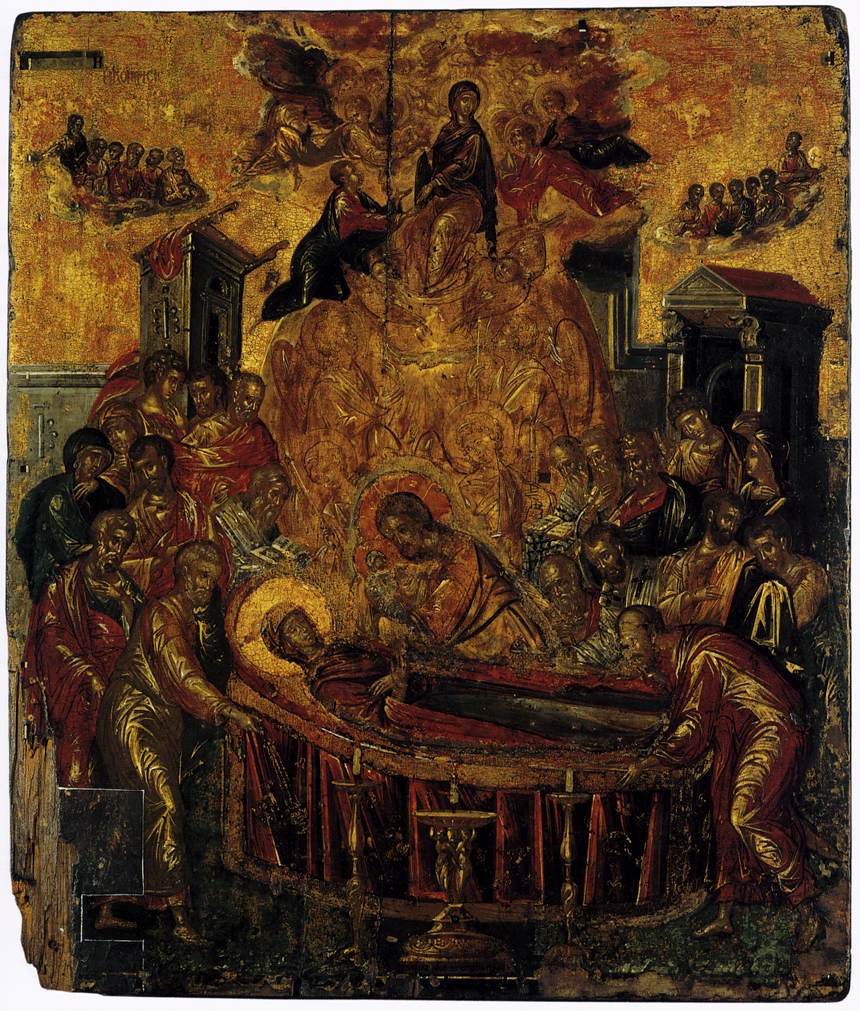
He created his second firmly attributed work from this phase for the Church of the Dormition of the Virgin in Ermoupolis, Syros. The Dormition of the Virgin (fig. 2) depicts the scene of the Virgin’s death (or translation) and is tempera on panel with gold. The lower register carries the grief of the earthly mourners, with the Virgin horizontally centered; Christ, represented as both child and adult, descends to receive the Holy Mother into heaven. Better preserved than St. Luke, the icon more fully previews El Greco’s later compositional logic: compressed, near nonexistent space. The Dormition also telegraphs his approach to color and to quick, bright highlights that reappear in Spain. Various catalogues raisonnés attribute other icons to his hand, but those attributions are questionable at best.
Besides his status as a master painter, documents discovered in the Venetian archives record that he commanded high prices for his icons.[4] Those records also show that El Greco did not leave his homeland of Candia, Crete (now Heraklion), until age twenty‑seven, much later than once thought.[5][6]
His departure from Crete remains unclear, and records document his travels in Italy imperfectly. He spent time in the Farnese orbit, where he likely encountered Michelangelo’s drawings,[7] and then moved to Spain. Two royal commissions under Philip II set the stage for Toledo. Although Philip II rejected the second painting,[8] he remained in Spain for the rest of his life, working in Toledo.
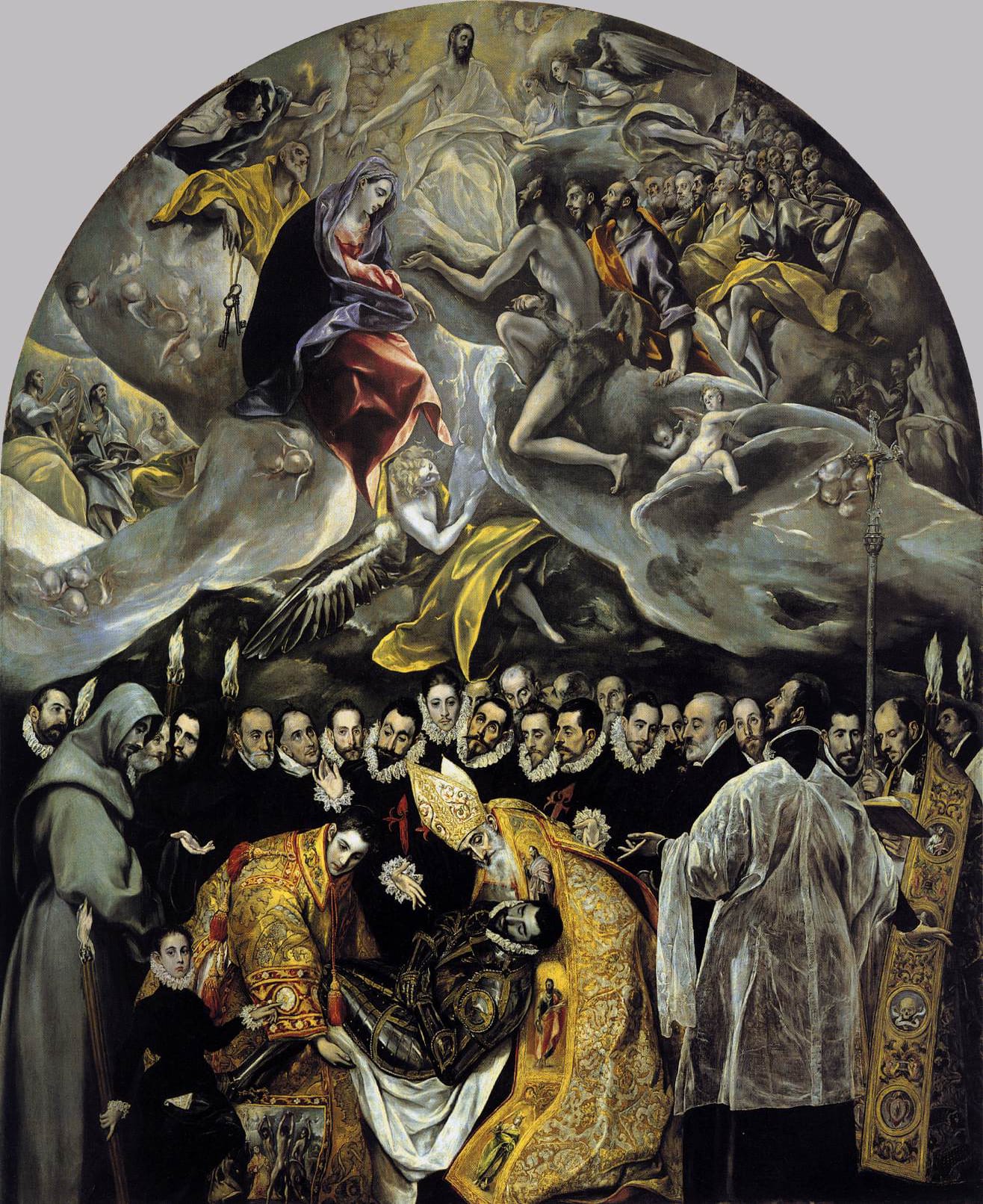
For centuries after his death, the few references to El Greco caricatured him as mad or astigmatic.[9] In the early twentieth century, scholars such as Manuel B. Cossío, Francisco de Borja de San Román, and Elizabeth du Gue Trapier reopened the case and restored his stature. In 1962 Harold E. Wethey dismissed the eyesight theory by visual analysis of The Burial of the Count of Orgaz (fig. 3),[10] and Stuart Anstis later demonstrated experimentally that the elongations cannot be blamed on vision defects.[11][12]
This is the Vasari Effect at work: a useful story that quietly picks winners. We must also be careful with labels. Calling him a Byzantine icon painter is accurate; calling him a “Mannerist” can be reductive. Max Dvořák first attached the Mannerism tag; Harold E. Wethey extended it, again with little regard for the Cretan career.[13][14] Wethey writes:
Critics who have objected to the classification of El Greco as a Mannerist have done so because of their restricted view of the subject. Those who have limited Mannerism exclusively to the followers of Michelangelo and to the school of Fontainebleau with its essentially decorative character have missed its most significant aspects. These artists who are comprehensible in relation to Vasari’s theory of “grace” in art, should be regarded in a separate category as representative of the academic and the courtly phases of a broad and divergent artistic movement.[15]
By “Vasari Effect,” I mean this: Vasari’s taste and taxonomy, rooted in Tuscan disegno and the idea of “grace,” became the frame through which later writers sorted painters. When that frame lands on El Greco, a Cretan icon painter who argued divinity in colore, the fit distorts: he becomes “Mannerist,” Toledo becomes “mature,” and Crete fades into a preface. The label travels forward; the context falls away.
The problem is that almost no “Mannerist” had a full first career as a successful Byzantine icon painter. The objection is not a restricted view of Mannerism, but the restrictive view of El Greco that the label creates. Boxing him as “Mannerist” skews how we read his choices from the start. He clearly knew Michelangelo’s work, but not as an imitator; rather, he showed that colore renders the divine as beautifully as disegno does, an allegiance easy to imagine for a painter from Venetian‑ruled Crete.
Posthumous inventories show he owned Vasari’s Lives of the Artists,[16] and marginal notes indicate he read it closely.[17] He criticizes Michelangelo’s color while praising his drawing.[18] Throughout El Greco’s career, disegno tends to anchor the earthly, while colore becomes the site where the divine breathes. In Portrait of a Cardinal (fig. 3), architecture (two walls and a tiled floor) anchors the sitter, and crisp white highlights articulate the deep red vestments. Though the subject is religious, it is not divine; hence he gives weight to anatomy and design.

Conversely, in overtly religious scenes El Greco can suppress disegno to mark the divide between worldly and divine. The paradigm is The Burial of the Count of Orgaz (fig. 4), where a fully constructed terrestrial tier yields to a visionary upper register, a fusion of icon painter training and Western narrative space.
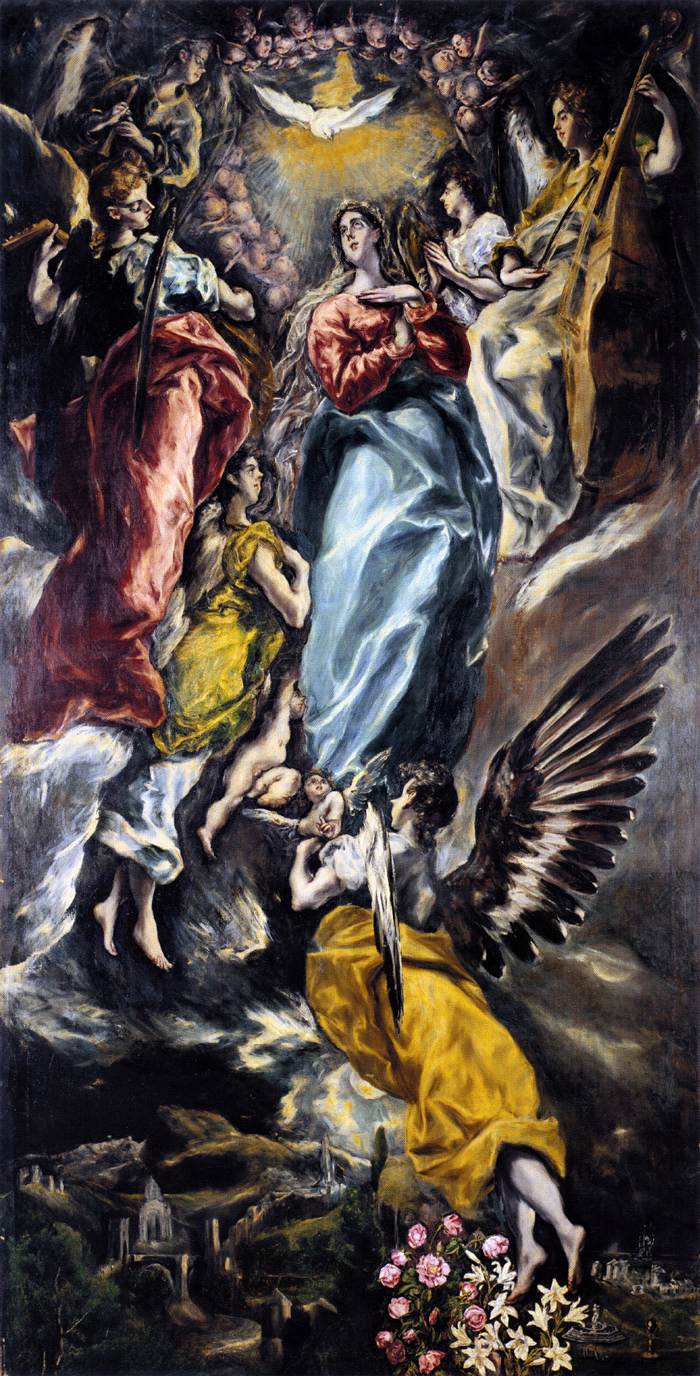
The Virgin of the Immaculate Conception (fig. 5) is a revealing junction between Orthodox formation and Catholic commission. Painted for the Oballe Chapel, it treats a Catholic dogma (largely rejected in Greek Orthodoxy) through a Greek lens: saturated color and rapid, almost flaring highlights. One can draw a direct line back to The Dormition and St. Luke in the handling of light on form.
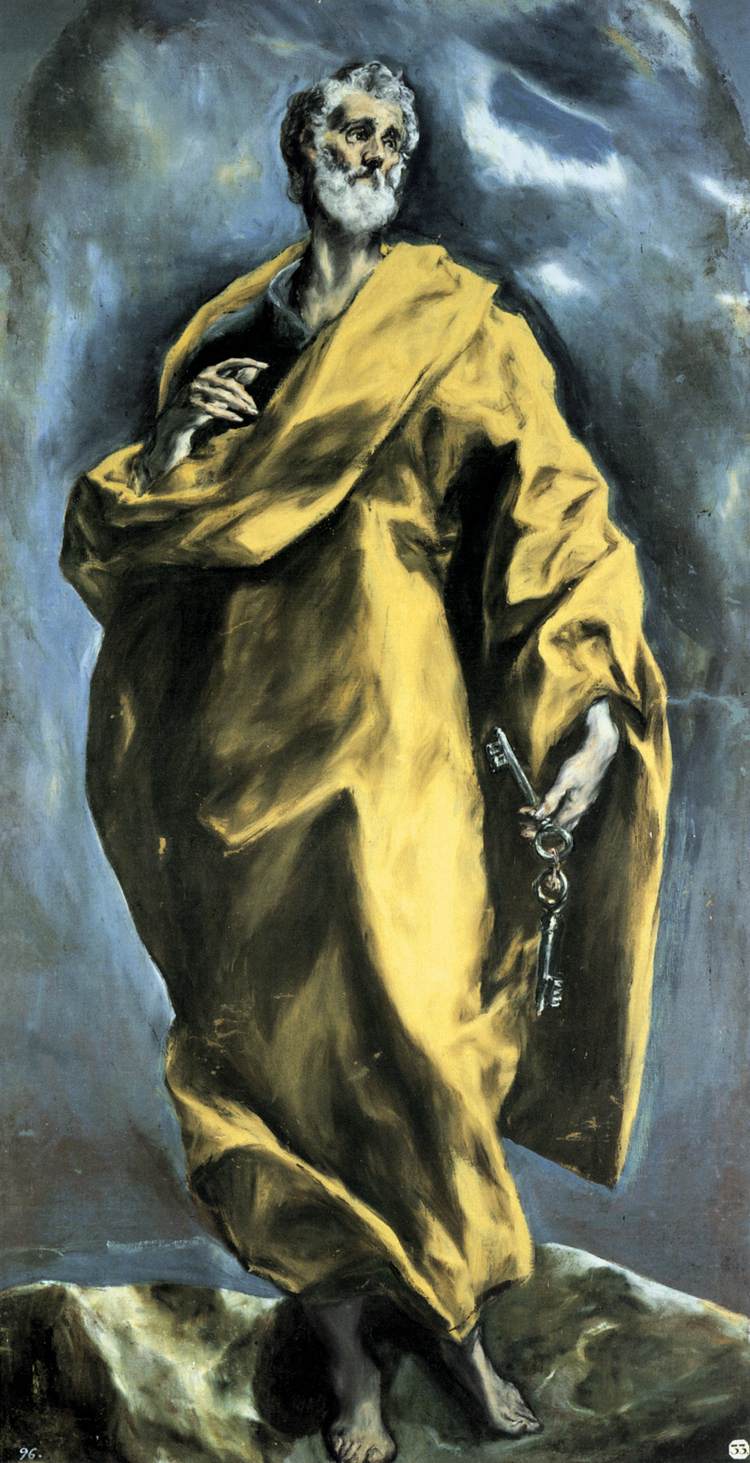
A companion case is Saint Peter (fig. 6), also for the Oballe Chapel and now at El Escorial. The face and hands are more firmly structured, but the cloak carries the loose brushwork we associate with celestial subjects. The stormy blue‑gray field throws the apostle forward, very icon‑like in its frontal authority, even as he stands on rock within “natural” space. The visual evolution and continuity of style is one of the most direct connections between his work as a Byzantine icon painter and his later Western practice.
Historians have been so quick to label El Greco that we do not recognize the fact that he was Doménikos Theotókopoulos first, and was a master painter before he ever left Crete.
[…A]nother question that is far from being answered is the importance of the painter’s Byzantine background in his evolution in Spain. Nowadays [sic] historians continue to be divided into those who see El Greco’s Byzantine background as a determining weight in his evolution, and those who limit themselves to mentioning the existence of “Byzantine reminiscences” in his Spanish works without giving them much importance. In any case there is a certain consensus that El Greco occasionally continued to use compositional schemes and formal or iconographic motifs that originated in Byzantine painting in his mature work. [19]
Scholarly references to El Greco’s Western work as his “mature work” are incorrect, misleading, and naïve. We need to find a better lexicon when speaking about the works of Doménikos Theotókopoulos. A new examination of his works without the discrimination against his early period will provide new scholarly evidence for the life of the artist. Using words such as “mature” to describe his later works is grossly misrepresentative of his oeuvre. We, literally, need to start from the beginning, and review the information available regarding this artist with a fresh attitude, devoid of prejudices.
Doménikos Theotókopoulos, a painter from the island of Crete, fashioned two distinct careers: one, alla Greca, the other alla Latina, and he interlocked them; Harold E. Wethey even titled chapter five of his monograph and catalogue raisonné “The Genius of El Greco.” [21] El Greco seamlessly combined the traditions of the Byzantine icon painter with the theories of Western painting to produce a style completely his own. In the past, art historians have almost completely avoided the topic of his Cretan roots, and only touched lightly on his time spent in Italy.
This approach is dangerous and leads us to classify his later works as “mature” works, even though the record shows that he worked as a well‑paid master painter in his homeland of Crete. [20] This treatment of his years before Spain negatively affects the reading of his works throughout his life. Denying his religious Cretan background, while suppressing the influence of his time spent in Italy, inhibits a thorough understanding of this artist and his oeuvre.
Start from Crete and the Vasari script loosens; Toledo stops looking like arrival and starts reading like amplification.
Endnotes
[1] Panagiotakes, El Greco: The Cretan Years, 18.
[2] Álvarez Lopera, “The Construction of a Painter: A Century of Searching for and Interpreting El Greco,” in El Greco: Identity and Transformation: Crete, Italy, Spain, 23–53. (Recent additions include the Prado catalogue by Leticia Ruiz Gómez; Lopera remains foundational.)
[3] Álvarez Lopera, “The Construction of a Painter,” 52.
[4] Panagiotakes, El Greco: The Cretan Years, 33 (on pay/status; long quotation in original).
[5] Panagiotakes, El Greco: The Cretan Years, 30.
[6] Wethey, El Greco and His School, 5 (revising earlier chronology; prior consensus placed training in Venice and a shorter Cretan phase).
[7] Trapier, El Greco, 96 (Farnese Palace drawings by Michelangelo likely seen by El Greco).
[8] Bray, El Greco, 17–20 (Philip II commissions; The Martyrdom of St. Maurice, 1580–81, El Escorial, led to no further royal commissions).
[9] Trapier, El Greco, 2–3.
[10] Wethey, El Greco and His School, 96, note 165 (on Burial of the Count of Orgaz disproving the “astigmatism” theory).
[11] Anstis, “Was El Greco Astigmatic?,” Leonardo 35, no. 2 (2002): 208.
[12] Anstis, “Was El Greco Astigmatic?”
[13] Wethey, El Greco and His School, 57.
[14] Wethey, El Greco and His School, 57 (on Mannerism scope).
[15] Vasari, Lives of the Most Eminent Painters, Sculptors, and Architects (1855), 242 (commenting on David and “grace”).
[16] Wethey, El Greco and His School, 3 (library inventory after 1614).
[17] Freedman, “El Greco’s Approach to Nudity,” Journal of Art History 69, nos. 3–4 (2000): 197–209.
[18] Bray, El Greco, 17.
[19] Álvarez Lopera, “The Construction of a Painter,” 52.
[20] Panagiotakes, El Greco: The Cretan Years, 25 (on familiarity with alla Greca and alla Latina before leaving Crete).
[21] Wethey, El Greco and His School (see ch. 5, “The Genius of El Greco”).
Bibliography
Anstis, Stuart. “Was El Greco Astigmatic?”. Leonardo 35, no. 2 (2002): 208-08.
Bray, Xavier. El Greco. New Haven, CT: Yale University Press, 2004.
Cheney, Liana. Readings in Italian Mannerism. New York: P. Lang, 1997.
Cossio, Manuel B. El Greco. Barcelona: Hijos de J. Thomas.
Freedman, Luba. “El Greco’s Approach to Nudity.” Journal of Art History 69, no. 3-4 (2000): 197-209.
Guinard, Paul Jacques. El Greco. Lausanne: Skira, 1956.
Trapier, Elizabeth Du Gue. El Greco. New York: The Hispanic Society of America, 1925.
Wethey, Harold E. El Greco and His School. Princeton, NJ: Princeton University Press, 1962.