praemissum
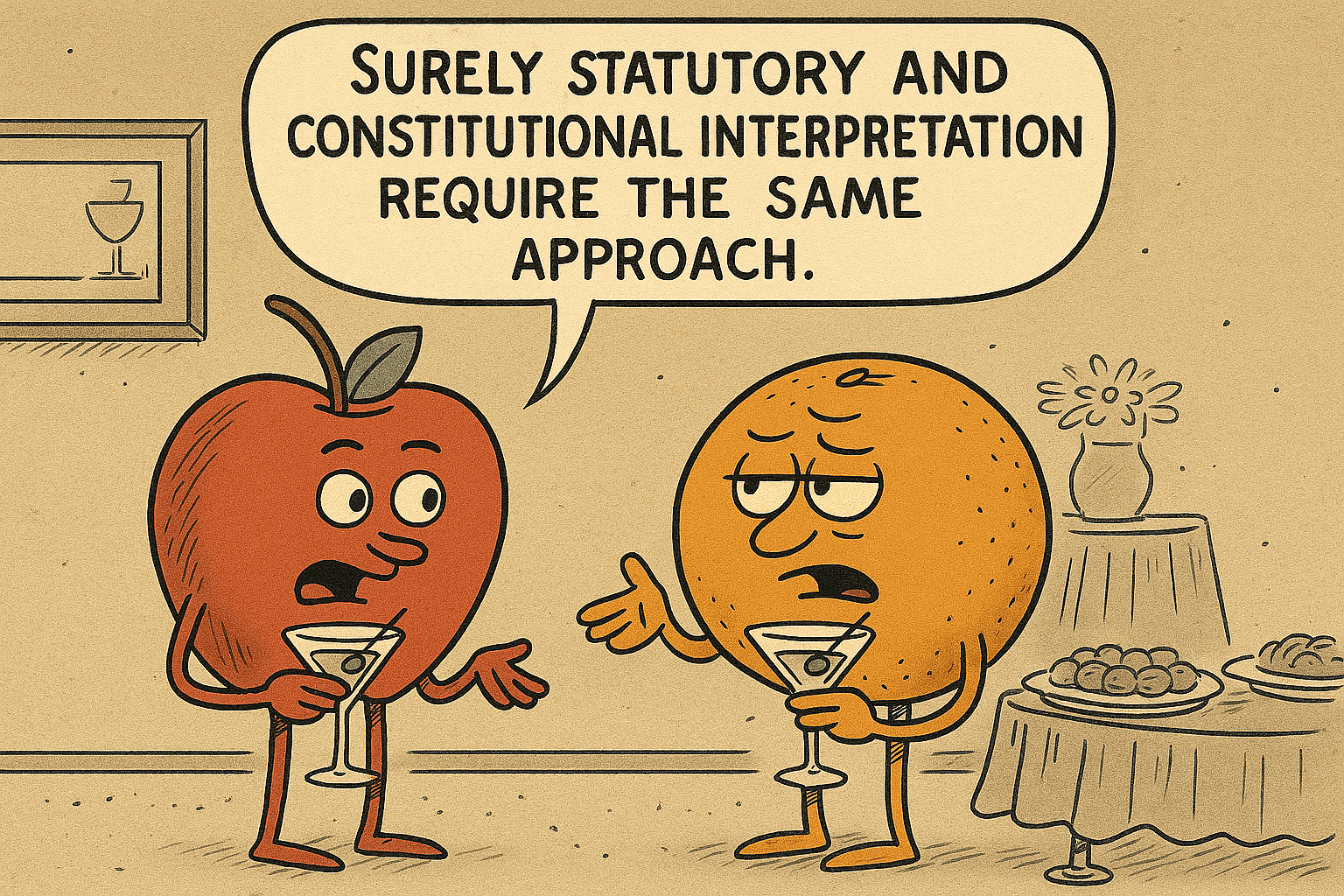
Do you think judges should approach issues of constitutional interpretation differently than how they approach issues of statutory interpretation? Why or why not?
responsum
At first, I would have said that they should be treated differently. I would liken this to a civil court versus a criminal court, and their differing standards of proof, but after further reading, I cannot. The approach to constitutional interpretation versus statutory, on the surface, seem to be two completely different beasts. While that may be so, in theory, should the approach of a judge ever change whether weighing the statutes against the constitution, or an entity against the statutes? I do not believe so.
A judge should always approach the law with a logic that is devoid of morality, values, bias, and legislation. Do they? No, no they do not, but in a perfect world, members of the judiciary would focus on the application of the law as it stands. It should be grounded in ethics, not personally held beliefs. We are not the Vatican, and as such, we do not have canonical law to judge We, The People’s morals. (Side note: I am making a lot of assumptions about canonical law. I do not actually know how it works.)
What really opened my eyes to the complexity of this question was an article in The Oxford Handbook of Jurisprudence and Philosophy of Law. The seventh chapter is an article Constitutional and Statutory Interpretation by Kent Greenawalt. Greenawalt goes into great detail about everything one could want to know about this topic. He also does it in a way that makes it understandable by providing simple real-world analogies to explain each element’s application. One issue that seemed ever-present throughout was legislative intent and its reception. He compared this to a writer’s intent and a reader’s understanding. Without this synergy, laws are ineffective at best, or even worse, unconstitutional. He illustrates this concept by explaining the different tools that one may apply to both statutory and constitutional interpretation.
In one famous case [Church of the Holy Trinity v. United States, 143 US 457 (1892)], the Supreme Court construed a law that barred employers from making contracts with aliens to perform labor or service of any kind in the United States. Although the specific statutory language was broad enough to cover the church’s contract with a British minister, the Court said the statute was aimed at manual laborers, not at brain toilers, and especially not at ministers of the gospel. Justice Antonin Scalia, a prominent textualist (i.e. an originalist who relies on textual meaning, not legislative intent), has expressed powerful disagreement with the approach of that case: when specific words are relatively clear, courts should follow them, leaving legislatures to correct their own mistakes.1
The part that I find most striking is Antonin Scalia’s opinion regarding the legislators’ need to correct their own mistakes. Even though Scalia is known as a textualist that focuses on the meaning of the text rather than legislative intent, he still has to consider it in some sense, since he states that the legislature “needs to correct their own mistakes.” That seems to not only affirm the pervasiveness of the legislature’s intent, but incontrovertibly forces the legislature to create clear and concise legislation with no doubt in their intent. This also creates separation between the powers by delineating the power of the court and the power of Congress.
I believe that is what we are actually seeing in the recent, more controversial U.S. Supreme Court cases. We are seeing a Supreme Court that is telling our elected officials that they need to do their job; that they need to legislate these issues. The Supreme Court is not there to legislate from the bench, which they should not be. They are a check and balance in the grand scheme of the United States government, and as such, they should (which has not always been the case) provide statutory and constitutional interpretation of the law, and nothing else. We are seeing this in majority, concurring, and dissenting opinions.
In the Supreme Court case McGirt v. Oklahoma, Neil Gorsuch, writing for the majority, states: “Today we are asked whether the land these treaties promised remains in Indian reservation for the purposes of federal criminal law. Because Congress has not said otherwise, we hold the government to its word.”2 Those are some pretty powerful words directed at our elected officials telling them that they need to address this. We see similar statements in Dobbs v. Jackson Women’s Health Organization, and also in Garland v. Cargill, which invokes the rule of lenity.3,4
Per Cornell’s Legal Information Institute, “[t]he rule of lenity is a principle used in criminal law, also called rule of strict construction, stating that when a law is unclear or ambiguous, the court should apply it in the way that is most favorable to the defendant, or to construe the statute against the state. The rule of lenity stems from two constitutional objectives: first, the separation of powers, as it limits the scope of statutory language in penal statutes and does not allow the courts to establish the contours of a crime and its punishment. Second, the rule of lenity stems from the wish to “protect the legislature’s constitutional lawmaking prerogative, and to limit the courts’ encroachment on a legislative function.”5
While there are many varieties of philosophies, rules, doctrines, and canons of construction as it concerns constitutional and statutory interpretation, the one issue that seems to permeate the entirety of jurisprudence according to the American Federal system is legislative intent, and whether its application is constitutional and/or statutorily sound, but this is all dependent on whether or not our elected officials did their due diligence in proposing, writing, and enacting our laws. The Supreme Court is not a third member of the U.S. Government in regard to a direct participation in the legislative process. The Supreme Court is more like the big brother that one would ask for advice as to whether something is appropriate or not. They do not make the laws; they clarify and nullify. They are the referees reviewing the rule book, and as such, they should always approach its interpretation – whether constitutional or statutorily – with equity, ethics, and logic.
As I waited for the Greenawalt article to arrive, I found another one on this topic, but from the standpoint of Zimbabwe. It is very interesting to see the theoretical application of these concepts – constitutional and statutory interpretation – via a country with a common law system, a(n allegedly) distinct judiciary, a constitution (as of very recently), and a Republican Democracy, (allegedly). Robert Mugabe is a major figure in Zimbabwean history. Keeping in mind this country’s executive, legislative, and judicial history, which is mostly antithetical to the history of the U.S. Federal government, I would recommend reading it.6
It is worth remembering that prior to Marbury v. Madison in 1803, the Supreme Court did not formally hold the power to interpret the Constitution at all. That authority was, in effect, claimed by the Court itself. As the decision famously established: “the courts [have the right] to determine the constitutionality of the actions of the other two branches of government.”7 And from that moment on, the interpretive power has belonged to them—constitutionally, statutorily, and otherwise.
In sum, I guess the answer to the original question is, “No.”
Footnotes:
- https://doi.org/10.1093/oxfordhb/9780199270972.013.0007
- https://www.supremecourt.gov/opinions/19pdf/18-9526_9okb.pdf
- https://www.oyez.org/cases/2021/19-1392
- https://www.oyez.org/cases/2023/22-976
- https://www.law.cornell.edu/index.php/wex/rule_of_lenity#:~:text=The%20rule%20of%20lenity%20is,the%20statute%20against%20the%20state
- https://tulsacommunitycollege-library.on.worldcat.org/oclc/9205862818
- https://www.archives.gov/milestone-documents/marbury-v-madison