praemissum
Use Google or another search engine to find Oklahoma’s state constitution. What are three ways that Oklahoma’s constitution is different from the U.S. Constitution? Why do you think these differences exist? Why do you think it is better and/or worse?
responsum
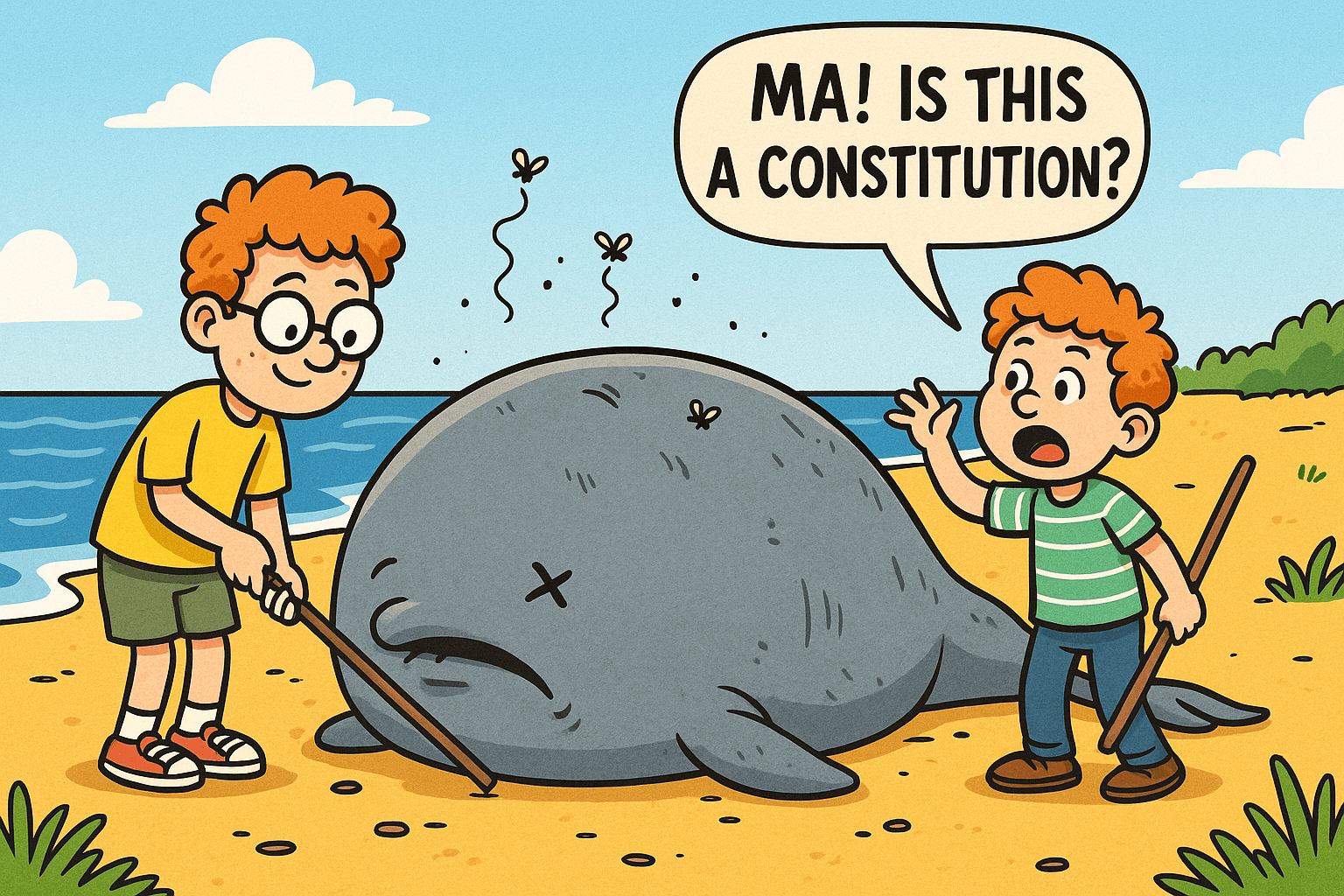
My first impression upon seeing the Oklahoma Constitution was, “Dear Lord, why did Oklahoma have to write such an excessively long constitution?” Coming from me, that is quite the accolade. But seriously, I reviewed the U.S. Constitution and Oklahoma’s both in PDF form, and I was stunned by the fact that we can print the entire foundational document of the United States (amendments included) in just 18 pages. Oklahoma’s clocks in at a staggering 221.
While searching for a reason to explain this monstrosity, I stumbled upon a short film from OsiyoTV—Cherokee Almanac: State of Sequoyah. Before watching it, I had no idea there was ever an attempt to create a split-state solution (sound familiar?): the western part Oklahoma, the eastern-side Sequoyah. I did not think the video would be relevant, but that changed when I heard them say a significant portion of the Sequoyah constitution was later used in crafting Oklahoma’s. Suddenly, things started to make more sense. The drafters merged two cultures, densely and awkwardly, with very little concern for brevity.
The Preambles offer another major contrast. Whereas the U.S. Constitution makes no mention of God (aside from dating), both the Sequoyah and the Oklahoma constitutions open with invocations of the “Almighty God.” Oklahoma’s even adds a bit of performative flair. And that’s just the start.
Besides the uncanny resemblance, and the similar effort to cover every possible legal, tax, corporate, civil, bureaucratic, and metaphysical situation known to humanity, the Oklahoma Constitution feels excessively redundant. Not just internally, but also in its overlap with the state’s statutes. Why do we need a statute that says what the Constitution already says? And if a statute says it, why sanctify it again in the Constitution?
This line of questioning comes from a belief I have long held: one of the U.S. Constitution’s greatest strengths is its brevity. Its ideas can be memorized. Internalized. Recalled when needed. I am not saying everyone should know every word, but we should at least be able to name the key articles and amendments, or recall (without consulting Google) that the President serves two terms and that Freedom of Speech is an inalienable right.
I can recite large portions of the U.S. Constitution. Oklahoma’s? Not so much. Beyond the Almighty God intro (which is easy enough to remember growing up in a Southern Baptist church), I know there are also references to alcoholism and corruption somewhere in there, but that’s about it. If I needed to find a particular protection, I would have to search it in real time.
And is that not the entire point of a constitution? To serve as a clear and accessible guide for the people it governs? A readable social contract? It should be a roadmap, not a riddle. Preferably, it should be written in a succinct format, not unlike the one designed for the nation itself. If that is the standard, then I would argue Oklahoma’s constitution fails. And it does so, spectacularly.
Footnotes:
https://osiyo.tv/cherokee-almanac-state-sequoyah/
https://www.govinfo.gov/content/pkg/GPO-CONAN-2022/
https://oksenate.gov/sites/default/files/2019-12/AllOKConstitutionArticles.pdf
https://constitutioncenter.org/media/files/constitution.pdf
https://sites.rootsweb.com/~oktttp/IT/sequoyah/Constitution.htm#