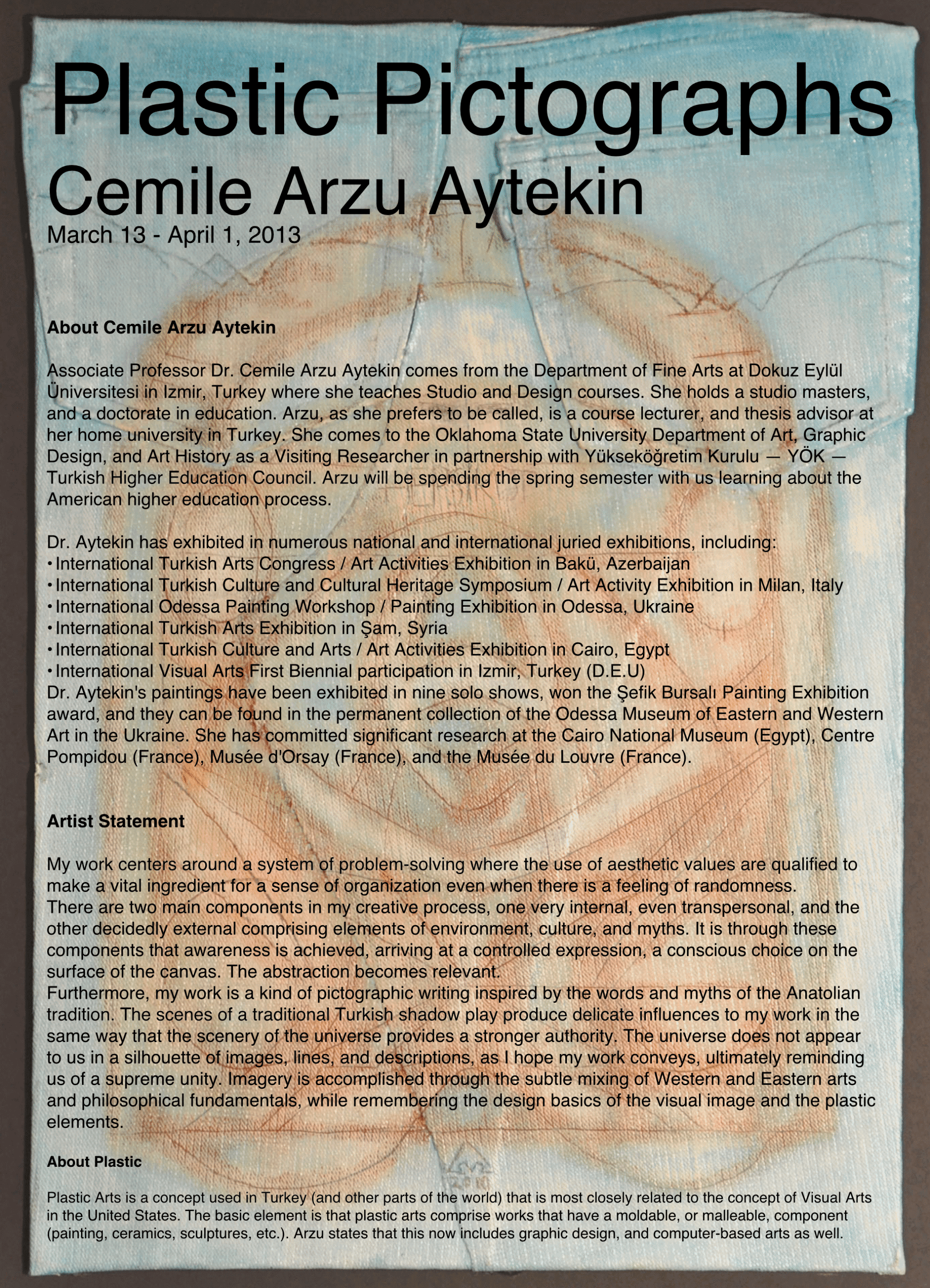
I had the privilege of translating the artist statement and curriculum vitae of Prof. Dr. Cemile Arzu Aytekin, a renowned painter and scholar at Dokuz Eylül University in Turkey. Her work draws from the Anatolian mythic tradition, Turkish shadow plays, and a philosophical blend of East and West, transpersonal aesthetics and modern abstraction. You can view her official university profile here.
While I am not fluent in Turkish, I approach translation as an interpretive and investigative craft — studying grammar patterns, researching cultural and visual references, and reconstructing meaning with linguistic empathy and artistic sensitivity. The final English version resonated so deeply that it drew attention from across the university, with multiple faculty members citing it as an exemplary translation of how an artist statement can maintain its depth, clarity, and creative fidelity across language and culture.
Dr. Aytekin’s Original:
Resimlerimde öncelikle malzeme üzerinde yoğunlaşma ve düsünme ile gelişen, bir sorun çözme süreci olarak, değerlerle düşünme, nitelikli estetik değerler içerisinde rastlantısallıkları belli bir organizasyonun olmazsa olmazı haline getirme sözkonusu.Yaratıcı süreçte içsel (ben ve ben ötesi, duyulurüstü) ve dışsal (çevre, kültür, mitler) farkındalıkların (sözcükler ve gölge tasvirler) denetimsiz bir dışavurumu değil, bilinçli bir seçimle tuval yüzeyindeki göstergelerin soyutlamalar olarak görünür hale gelmesi sözkonusudur . Resimlerim sözcükler ve mitlerden beslenir. Anadolu geleneğindeki gibi resim de bir çeşit yazı gibidir. Batı ve Doğu sanatlarının ve felsefesinin karması olan resimlerde yazı aynı zamanda resimde görsel/plastik bir unsurdur . Resimlerimdeki düşsel imgeler gerçeği temsil etmekten öte, bir araştırma, soruşturmadır. Geleneksel Türk gölge oyunlarında olduğu gibi, evrenin büyük bir sahne olduğunu ve bu sahnede silüet görüntülerin iplerinin görünmediğini ve bu sahnede yeralan tasvirlerin hep bize o yüce birliği hatırlattığını düşünüyorum.
| Turkish | Translation |
|---|---|
| “Resimlerimde… bir sorun çözme süreci olarak, değerlerle düşünme, nitelikli estetik değerler içerisinde rastlantısallıkları belli bir organizasyonun olmazsa olmazı haline getirme…” | “Bir sorun çözme süreci olarak” → “a form of problem-solving.” “Değerlerle düşünme” → “thinking through values.” “Nitelikli estetik değerler içerisinde rastlantısallıkları…” → “within a refined aesthetic structure, randomness….” “…olmazsa olmazı haline getirme” → “transformed into an essential component.” |
| “Yaratıcı süreçte içsel (ben ve ben ötesi, duyulurüstü) ve dışsal (çevre, kültür, mitler) farkındalıkların… bilinçli bir seçimle tuval yüzeyindeki göstergelerin soyutlamalar olarak görünür hale gelmesi…” | “içsel (ben ve ben ötesi, duyulurüstü)” → “internal awareness (the self and beyond, the supra-sensory).” “dışsal (çevre, kültür, mitler)” → “external awareness (environment, culture, myths).” “bilinçli bir seçimle” → “through deliberate choice.” “göstergelerin soyutlamalar olarak görünür hale gelmesi” → “signs on the canvas surface take shape as abstractions.” |
| “Resimlerim sözcükler ve mitlerden beslenir.” | “Resimlerim sözcükler ve mitlerden beslenir” → “My paintings are nourished by words and myths.” |
| “Geleneksel Türk gölge oyunlarında olduğu gibi… tasvirlerin hep bize o yüce birliği hatırlattığını düşünüyorum.” | “Tasvirler” → “figures, images, or representations, but not ‘illustrations.’” “Yüce birlik” → “greater unity, supreme unity, divine unity.” “Hatırlattığını düşünüyorum” → “I believe they remind us.” |
BRANDON’S TRANSLATION:
My work centers around a system of problem-solving where the use of aesthetic values are qualified to make a vital ingredient for a sense of organization even when there is a feeling of randomness.
There are two main components in my creative process, one very internal, even transpersonal, and the other decidedly external comprising elements of environment, culture, and myths. It is through these components that awareness is achieved, arriving at a controlled expression, a conscious choice on the surface of the canvas. The abstraction becomes relevant.
Furthermore, my work is a kind of picture writing nourished by the words and myths of the Anatolian tradition. The scenes of a traditional Turkish shadow play produce delicate influences to my work in the same way that the scenery of the universe provides a stronger authority. The universe does not appear to us in a silhouette of images, lines, and descriptions, as I hope my work conveys, and reminds us of a supreme unity. Imagery is accomplished through the subtle mixing of Western and Eastern arts and philosophical fundamentals, while remembering the design basics of the visual image and the plastic* elements.
*Plastic Arts is a concept used in Turkey (and other parts of the world) that is most closely related to the concept of Visual Arts in the United States. The basic element is that plastic arts comprise works that have a moldable, or malleable, component (painting, ceramics, sculpture, etc.). Arzu states that this now includes graphic design, and computer-based arts as well.