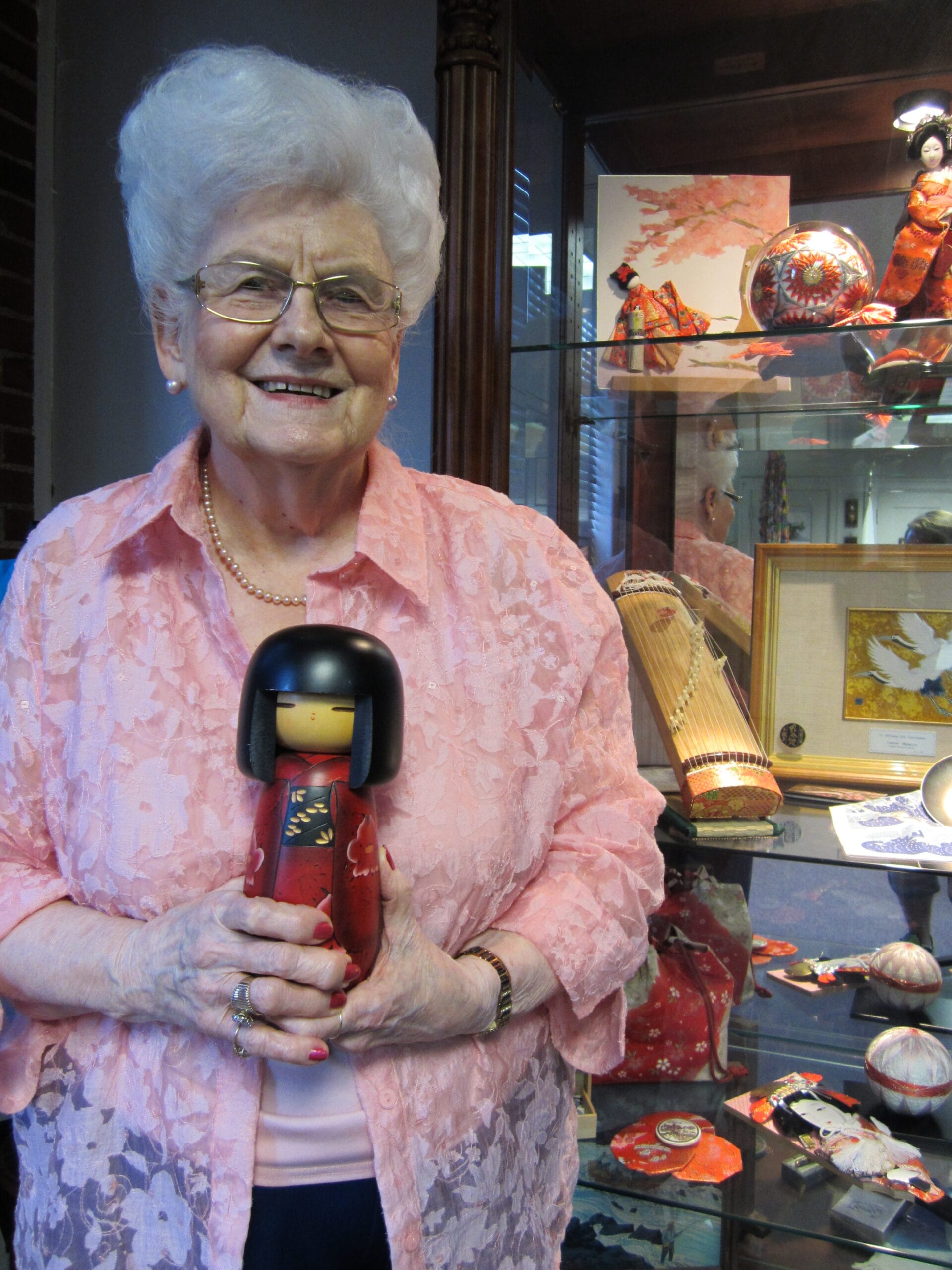
About This Interview:
Oral history interview with Sylvia Duncan, charter member of Stillwater’s Sister Cities Council, reflecting on 30 years of cultural exchange with Kameoka, Japan. Topics include the founding of OSU-K, Japanese gardens, trilateral exchanges, and citizen diplomacy.
About Sylvia Duncan:
Sylvia Duncan dedicated over three decades to building a bridge between Stillwater, Oklahoma and Kameoka, Japan. In this interview, she walks us through rainstorms, cookouts, kimono fittings, and public diplomacy — all part of the living fabric of one of the longest-running Sister Cities partnerships in the United States.
Working from President Dwight Eisenhower’s inception of Sister Cities International, Oklahoma established a relationship with Kyoto Prefecture, Japan, in 1985. Eisenhower’s nonprofit organization was established for the purpose of creating and maintaining global connections, and since its origin, the relationships across the globe now number in the thousands. As a result of the Oklahoma-Japan connection in 1985, Stillwater became the sister city of Kameoka.
To maintain the new relationship, a local council was formed, in charge of creating by-laws, guidelines, and city government connections. The original council consisted of nine members, one of whom was Sylvia Duncan. In her professional career, Sylvia Duncan was the first woman president of the Oklahoma Society of CPAs and the first woman chair of the State Board of Accountancy. She was treasurer of the National Association of State Boards of Accountancy and was on the American Institute of CPAs Board of Directors.
On the Kameoka council, she was able to work with her passion for international relations, helping write the council’s by-laws, and remaining on the council for its current thirty-year duration. Since 1985, Stillwater and Kameoka have shared cultural and educational exchanges and programs, and have worked diligently to create cross-cultural acceptance and integration within the different societies.
In this interview, Sylvia reflects on the enduring legacy of the Stillwater–Kameoka partnership and the human connections that have shaped its story.
Transcript of Oral History Interview with Sylvia Duncan (2015)
SOK Oral History Project
Interview of SYLVIA DUNCAN
07/16/2015 – Stillwater, Oklahoma
BJ: Brandon Jones
SD: Sylvia Duncan
BJ: My name is Brandon Neal Jones and today is July 16, 2015, and we are here in the Kameoka Room of the Stillwater Community Center as part of the Spotlighting Oklahoma Oral History Series of the Oklahoma Oral History research program. I will be interviewing Mrs. Sylvia Duncan on the Sister Cities International relationship between Kameoka, Japan and Stillwater, Oklahoma. Thank you for joining me today.
SD: Thank you.
BJ: So, Mrs. Duncan, let’s just start right at the beginning. Let’s start with the founding of this relationship and who the key players were.
SD: All right, we need to go back to 1985 when the State of Oklahoma and I think principally the Department of Commerce formed a relationship with Kyoto Prefecture in Japan. And…then they decided, the Department of Commerce, that it would be good if there would be a city in Oklahoma that would have a sister city in Kameoka, Japan. Now, going way back to 1956, then President Dwight D. Eisenhower had the idea that there should be citizen diplomacy and he had presented this idea but it was not until actually in 1967, I believe, that the organization Sister Cities International was formed as a non-profit organization. And the whole idea was that if relationships could be built between citizens of cities around the world from them that there would be common understanding and it would be truly citizen diplomacy.
Now back to Stillwater. There were some people who thought this would be an excellent idea for Stillwater to have a sister city relationship. At that time the mayor of Stillwater was Mayor Chris Salmon, who was an architecture professor at the university. However, she was not…the one who really signed the agreement. She did send a three-member, well rather, Kameoka sent a three-member fact-finding delegation to Stillwater to see if the City of Stillwater would fit what Kameoka wanted, which was not too far from the capital of the state, an economy based on agriculture and also the home of a university. So all those things seemed to fall in place. So finally then, in November of 1985, a twelve-member delegation went from Stillwater and at that time it was headed by Mayor Calvin Anthony. And in Kameoka, on November the third, 1985, Mayor Anthony and Kameoka Mayor, Yoshihisa Taniguchi, signed the formal documents establishing the sister city relationship, which, as I think you noted, is now in our 30th year of that relationship. Now the delegation did come back to Stillwater determined to develop a dynamic program. And I feel that it has happened….
BJ: Can I ask, were you a part of that original twelve-member delegation?
SD: I was not a part of that original twelve-member delegation. However, upon their return to Stillwater they did make a call for interested individuals to come together and I was one of those who met at the City Hall and we…we were given the charge to form a council, write by-laws, and become an integral part of the city government. And I was one of the original nine members of that council and I actually did the major part of the work on writing the by-laws. And actually, I am known as the charter member of the council because I have been on the council continuously for these 30 years and actually the only one—now Larry Jones was on the original council, but he took a leave from the council duties when he went to Kameoka to be on the faculty of OSU-K, which was established in the city of Kameoka.
BJ: Okay. So now, let’s go back to that founding of the Sister City Council. The original twelve-member delegation, they went over in November of 1985. And then on November 3rd, in Kameoka, Calvin Anthony and Mayor Taniguchi signed the agreement and then they came back and they delivered, or they sent out a call for citizens to begin this council. So tell me about those first days with the council. You mentioned that you had written the by-laws, but tell me a little bit of your personal experience with the council. And what made you want to join this council–what was your original interest.
SD: I had prior to that time been involved in teaching English to international students here on the OSU campus. And I just had an interest in international affairs and relationships that were peaceful and enriching. And on that original council, in addition to Larry Jones was Dr. Harold Sare of the Political Science Department at the university, Ken McKinley, a woman named Dee Dutt, and we did have a city liaison, one of the staff people whose name I do not remember because he was a young man, but he did not stay in that position long. Rather, the Assistant City Manager, Mary Rupp, became the city official who was assigned to the council.
BJ: And her name was Mary Rupp?
SD: Uh-huh. R-U-P-P.
BJ: And in those first days of being on the council, what were some of the highlights, activities that you participated in, and that you led that really founded the starting of the council, you know—what are some things that really come to your mind as those first few days. What activities were you a part of?
SD: Well over a few days was actually the by-laws. But I don’t remember too much other than we decided that since the Japanese were so into beautiful Japanese landscape gardens that it might be appropriate if we established a Japanese garden at city hall. And a Japanese garden is called a kōen [k-o-e-n]. And we did set about and build a Japanese garden to the north of the municipal building and we did it with volunteer labor and we had a beautiful wooden sign fabricated that we hung really on Main Street but later at the Kameoka kōen, which indicated how many miles west that Kameoka was from Stillwater…
BJ: Oh, okay.
I remember one of the persons who was at our home had been in World War II and so had my husband. But they developed a very good rapport, and if I remember correctly, the man gave my husband a Japanese kimono. It was a lady’s kimono, but he, I mean, there was that relationship that developed even though they had formerly been war-time enemies. And that’s the whole idea of the Sister Cities is to develop friendships and understanding of we’re all alike as human beings.
Sylvia Duncan
SD: …Then we did have a large delegation come from Kameoka in 1987 and that really was the time of our second anniversary. It was November of 1987 and at that time we did establish–well we had prior to that time–but at that point we dedicated a walking trail, called the Kameoka Trail that starts in Couch Park. The head of that trail is just across the street north from what is the Senior Citizens Center now. And it goes clear to Boomer Lake. That is a walking trail.
BJ: I have walked that trail a few times myself out towards Boomer and that was my first experience with Kameoka and noticing the sign and kind of asking myself, “What is this that I’m seeing?”
SD: And then we did have a dedication of the Kameoka kōen.
BJ: Okay, and that was in 1987 for the second anniversary.
SD: Yes, that’s true.
BJ: Now, at what…
SD: See, we entertained that delegation from Kameoka and got individually acquainted with all those people who came.
BJ: And tell me a little bit more about the entertainment aspect of it as far as were you introducing them to native Oklahoman food, were you introducing them… I mean what kind of events do remember?
SD: Well, I remember hosting one in my home.
BJ: Tell me about that.
SD: I think this was the one that we had in the back yard. And it was a cookout. But, we had to quickly move inside when a rainstorm occurred. (laughing) But anyway, that was the kind of thing we did. We had meals in homes generally, sometimes in a restaurant. And we had some home stays. And I remember one of the persons who was at our home had been in World War II and so had my husband. But they developed a very good rapport, and if I remember correctly, the man gave my husband a Japanese kimono. It was a lady’s kimono, but he, I mean, there was that relationship that developed even though they had formerly been war-time enemies. And that’s the whole idea of the sister cities is to develop friendships and understanding of we’re all alike as human beings. But that’s what we did.
BJ: Now, let’s…so that was the second anniversary, let’s discuss your first trip to Japan. Have you made it? You have.
SD: Yes, I went to Japan I think in October of 1988. And I travelled with two others. A man named Dr. Joseph Fox, who was on the council, and then the mayor, Mike Henson, and we actually were invited to come to attend the forty-third national sports festival, which is held every year, I think every year, in Japan. It could be less than every year, but anyway, Kameoka was hosting some of the events…of that. Some were taking place in Kyoto but some were…. And I think maybe they have those events in different prefectures each time so that…in Japan the prefecture is the equivalent to our state. And Kyoto City is the capital of Kyoto prefecture, but the city of Kameoka is just about 35 miles from Kyoto City.
BJ: It’s due west, isn’t it?
SD: Pretty much.
BJ: And your first time in Japan, what are some of the feelings, the emotions, you know, your experiences while you were there? Did you fly in through Tokyo or did you fly in through…
SD: Kansai. Well, that time we came through Tokyo, I’m pretty sure. The next time I went we came through Kansai….the city of Osaka. Well, we were just waited on hand and foot. I mean we were treated so hospitably. And of course I was a little dubious of some of the food (laughing). I tried to not show that too much and go ahead and eat it and then … I believe it was on that trip that we stayed in a traditional Japanese inn with the tatami mats.
BJ: And those are called ryokan?
SD: I think that’s right, something like that
BJ: But you stayed at the traditional Japanese inn, with the tatami style…
SD: Uh huh
BJ: That’s very beautiful. And how long were you there? Kind of even an estimate….
SD: It was probably nearly a week. As I said, my 86-year-old memory eludes me sometimes when things happened nearly 30 years ago, I forget all the specific details.
BJ: No, I do understand that.
SD: I do remember about that traditional Japanese inn in the lobby they had a beautiful white, richly embroidered, embellished, wedding kimono.
BJ: Oh, I bet that was beautiful.
SD: And I know that Mayor Henson and I both, you know, had oohed and aahed over it, but the innkeeper said, well, “Would you like to try it on?” (laughing) And so we both had the opportunity to try this beautiful wedding kimono on.
BJ: That’s a memory that you probably just can’t forget isn’t it. And that was the wedding kimono in the lobby of the inn?
SD: Uh huh.
BJ: So that was your first trip into Kameoka, and what would be, you know, the next major event? Would you have gone back to Japan or did we have another delegation come between then?
SD: Well, we had quite a few delegations and then there was also the sister school relationship, which was established where we had… at least…well the first delegation that went from the Middle School to Japan was a rather large delegation of students and that was led by John Mills, who was the principal, and also a member of the sister city council. And then, in turn, in that sister school agreement, they would send at least a teacher and two students to Stillwater. And that alternated. It got to where we sent a teacher and two students and then the next year they would send a teacher and two students. And that happened up until the time that there was oh, some fear or apprehension about safety and then also the economic downturn in Japan. So there have not been as many of the educational exchanges. Now, uh…
BJ: Do you know what year that would have began or approximately?
SD: …Oh, I should know exactly, let me think about that a little. I do know that we had the opportunity through Sister Cities International to apply for some grants, and they were called Tri-Lateral grants, where it involved Stillwater, Kameoka, and a city in a third world country. And I actually had applied for, and I did the work in sending in the proposal to apply for…the first grant had to do with early childhood education. I believe I’m correct on that. We had one on early childhood education and another on lifetime learning. But I know I was at an organizational meeting in Irvine, California. We got both the grants, but they were years apart. One was like 1993 and 4 and the other was like 1996 or 7. But when I was in California for this organizational meeting, of the first grant, we had a large group of Japanese come. They were members of the social welfare foundation, and it was in the matter of lifetime learning, was the subject of the tri-lateral exchange. And they came while I was gone, it just so happened. And…
BJ: And they came here to Stillwater…
SD: They came here to Stillwater.
BJ: Okay, while you were in California?
SD: Yes, at least during the largest part of the time of their stay. But those visitors to Stillwater at that time were divided into groups and went to different places that would have been of interest to senior citizens, people with cognitive impairment, and maybe working women or women with home offices. This was a social welfare group and so these were some of the issues that they were interested in and so places for them to visit were in those areas.
BJ: So they were coming not only to open up this relationship and to create this dialogue between two communities, but they were also coming to learn about some of our programs and offerings that we have here in Stillwater, Oklahoma.
SD: For our citizens, yes.
BJ: So it was very much a learning experience for both cities.
SD: Right. But the second time I went to Japan was in 1995 in May of 1995. And this was sort of an evaluation meeting for representatives of all the cities that had been involved in the Tri-Lateral exchange.
BJ: By the way, a quick question–the third city that was involved…
SD: Alright, the third city. It was Jandira, Brazil, a sister city to Kameoka. And it’s rather interesting because lots of Japanese people had immigrated to Brazil. And that’s one reason they had…
BJ: That was the connection there for Kameoka. Okay.
SD: And in some of that Tri-Lateral exchange we actually had the mayor of Jandira and his wife to visit Stillwater, and…then later we had, well, John Mills and his wife went to Jandira as our…so there were, you know there were trips with all three cities.
BJ: Okay. And now you said your second time to Japan in May of 1995 that was an evaluation?
SD: Yes, it was an evaluation meeting and it was actually there we flew in to Kansai. Because the meeting actually took place in Osaka. And at that meeting I stayed in the Continental Hotel in Osaka. But I did go to Kameoka, as well, and Mayor Taniguchi was present at the meetings, of course, and so at that time there were three of us again who went and that was John Mills, Mike Henson, and myself. And I believe at that point Mike may not have been the mayor, but anyway, she was a…. and Mike sounds like a boy’s name, but she was a woman and she was a very close friend of mine. And so that was the second trip. And then John Mills also, because he was…that was on the early childhood education Tri-Lateral exchange. And even though he was the principal at the Middle School, his wife was a specialist in early childhood education.
BJ: And were there goals that were trying to be accomplished at this meeting, and what was being evaluated, I guess is a better question.
SD: All right, well, I will tell you, and I have sort of written out—on—the one with early childhood education, one of the results was that there were informative curriculum booklets for preschoolers developed and innovative teaching methods were shared. And in regard to both grants, there was the realization on the part of all the participants that basically human beings are all alike regardless of age and ethnicity, that we’re alike in so many ways. And so it led to the idea that these quality-of-life issues can impact world peace.
No, the Kameoka kōen went the way of many things in this life, because it had to be destroyed when the addition was built—the current police station.
Sylvia Duncan
BJ: Let’s see, now we’re in May 1995, is this getting close to about the time that the Japanese gardeners came over to build the garden that’s outside the….
SD: I believe they came in 1997.
BJ: And could you tell me a little bit more about that.
SD: All right. The idea arose in Kameoka that this garden would be a gift to Stillwater and they let us know that’s what they wanted to do and so they posed the problem of where it should be built and so we wrestled with that before they came, of course, but it was decided it would be here at the Community Building—Community Center. And there were seventeen gardeners who came, and they did…ship rocks from the Hozu River, which runs through Kameoka, large rocks, or stones I should say, to use. And they shipped the two different—I say two—I can visualize two different Japanese lanterns, but the large one that is in the garden… But we had another one that they had given us that we had in Kameoka kōen. But anyway, they shipped those stones and they made arrangements to rent large equipment, everything they could in Stillwater. But they had to get some things from Oklahoma City. But they bought plant material and probably expended, including their travel and accommodations, in excess of $100,000 dollars.
BJ: Quite a gift for Stillwater.
SD: Quite a gift, and then there were people who would come nearly every day the gardeners were working and watch them work and bring them something to eat or drink and they would sit on the lawn and eat. And one gentleman who lived somewhere in the neighborhood of the Community Center wanted to give them OSU football tickets. It was in the fall of the year—football season, and so that was what he did and they were able to go to a Saturday football game. And then, I think maybe about three years later, three or four of gardeners returned to check on how the growth was taking place and actually we had a little ceremony and it was named the International Friendship Garden, and there is a plaque that has all the names of the gardeners, which is engraved and in the garden. Now in addition to the garden here at the Community Center, they did build a small Japanese garden at the Botanical Garden at OSU.
BJ: Was that at the same time?
SD: It was done at the same time they built the garden here.
BJ: And just to clarify, the Kameoka kōen, is that still….
SD: No, the Kameoka kōen went the way of many things in this life, because it had to be destroyed when the addition was built—the current police station….
BJ: Okay, so we still have the International Friendship Garden out here and then we have the smaller garden at OSU Botanical.
SD: Yes. At OSU. Uh-huh.
BJ: Okay. And so now we’re up to about 2000’s, aren’t we?
SD: Okay.
BJ: I don’t want to rush anything, so if we skipped some major events that you would like to cover, please let me know. Because I know there’s thirty years of history, and it’s a rich history.
SD: Well, I was trying to think. One thing that we did in 1992, and that’s really going back prior to the garden. Sister Cities International annually has their annual international conference. And in 1992, Tulsa, Oklahoma was chosen as the locale for that, or the host, and so we did invite a large Kameoka delegation to come to Oklahoma to attend the international conference in Tulsa. And we entertained them there and here. And we did help with…the conference in Tulsa. And there were activities at like Gilcrease Museum in Tulsa where Native American Indians performed. One thing I remember about being at the conference in Tulsa was meeting the mayor of Timbuktu (laughing) I didn’t know you could use that word—we don’t know where Timbuktu is sometimes.
BJ: It’s an actual place. Yes.
SD: But anyway, that was a fun time. And we brought them back to Stillwater, I think, if I remember correctly, we brought the delegation back via Pawnee Bill’s.
BJ: Oh, okay.
SD: And so that’s one thing I remember about 1992 and then, that’s sort of you know, backing up before the social welfare group came. And in 1998, there was a group of Stillwater citizens who went to Kameoka for the dedication of a new building in Kameoka called Kameoka’s Galleria. And I know Steve and Becky Irby I believe were in that group. Becky is a member of the council [Sister City Council]. And then also that year we accumulated and received donations of gifts by Stillwater authors and those were taken to Kameoka as a gift from Stillwater to Kameoka for placement in their library. And then actually, moving on to the year 2000, that was the fifteenth anniversary of our relationship, and we had a Japanese delegation present here that time invited and Mayor Taniguchi came with them at that time. Then in 2002, and this was in January, it was the dead of winter, a group called the Kameoka Terreno Tono Ensemble came and presented a concert. And they were musicians who played what’s known as an ocarina, which is, I think, when I was a child, it was called a Jew’s harp. But these ocarinas that they played were made from clay that was dug out of the ground when they built this new Kameoka City Hall. So they were made out of native…. But there was a large group of them and we had a concert, their performance at the Wes Watkins Center. And it was on a January night when it was extremely cold and icy. And then we had a breakfast for them the next morning and they were going to leave that day and we had that in the basement area of the Public Library.
BJ: The ocarina group, who came from Kameoka in 2002, you talk about that being in the dead of winter and could you tell me, if you guess, how many people showed up to see this, because that’s…
SD: It was a huge crowd.
BJ: …That’s what I thought.
SD: It was a huge crowd.
BJ: So the snow and the ice did not….
SD: It did not deter them. But that next morning when we had the breakfast, and the sun was shining, but everything was just sparkling because all the trees were covered with ice and all the shrubbery, and, but, we told them goodbye.
BJ: And let’s see, so that’s in 2002? And I think the next big event is our twentieth anniversary is it not?
SD: Well, uh…
BJ: Perhaps we have a little something in between there.
SD: There might be some things in between, that perhaps were not directly sister city connected, but one of the professors from the Horticulture Department at OSU, Dr. Paul Hsu, who happens to be Chinese, but he had been taking groups to Japan to study the Japanese gardens…and so that was taking place in 2004, in that time frame. And in 2005, there was a Stillwater delegation that went to Kameoka….
BJ: This would be around the twentieth anniversary.
SD: Yes, that’s correct.
BJ: And this was a citizen and political delegation?
SD: It was mainly just a citizen delegation.
BJ: And you were on this trip?
SD: No. The two trips that I’ve mentioned, 1988, to the forty-third international sports thing and then the trip to—in ’95 to Osaka and then also to Kameoka. One thing I might mention that happened prior to the…2000 decade, you know we’re here in the Kameoka Room, my professional life has been as a certified public accountant and one of my long-time clients was Winfrey Houston, who’s been very active in the development of this old school building to become the Stillwater Community Center. And he kept talking to me he said, “We need a Kameoka Room in the Community Center.” And so he sort of placed it upon my shoulders. And he interceded with the Board of the Community Center that we be given a space designated as the Community Center.
BJ: And about what year was this?
SD: Well, I would really have to look on this plaque that’s on the wall over there, that lists on brass plates the people who donated and each of the three lighted cases, which are behind me, have a brass plate on them saying who donated the cases…
BJ: The objects inside. Or, the cases.
SD: …the cases. Now, all of the artifacts and things inside the cases are gifts from various official delegations or just friendly gifts to the City of Stillwater and some of the things have been given to individuals and then the individuals have given them to be on display here. But that was really one of my projects was to….
BJ: …Was putting together the room and…
SD: Putting together the room and then in addition to these three lighted cases that you see behind me, there is one in the lobby outside the Lowery Center. It’s just like these cases here. And it’s full of artifacts. And then there is another case in the room now, which is to my right, which the case and all of the artifacts in it were donated more recently by a doctor, a retired doctor who is leaving Stillwater, Dr. Charles Johnson, and his then-deceased wife, June. And most of the things the artifacts in that case were given to Mrs. Johnson through the years based upon some friendship that she had built with Japanese who were here in the military at different times. And then we have other cases in the room that were donated by Calvin Anthony, the then-owner of Tiger Drug.
BJ: The former mayor who started the…
SD: …who signed the sister city agreement, that’s correct.
BJ: Yes. And I know there’s another case here in the Stillwater Community Center with a Samurai…?
SD: Yes. And that was given to the city early on…
BJ: Oh, that’s an older gift.
SD: …very early, very early on. Let me tell you—the case was not given, the Samurai warrior was. The case was fabricated by one of the city employees, McLenny is his name. And it was built specifically to house the Samurai warrior and actually it was the original intent was for it to be in the Kameoka Room in the area in the west end. And he was very dismayed, as were all of us, when he couldn’t get it through the door into the room. He had measured so that all the Samurai fit in beautifully but that’s the reason it’s also in the lobby outside the Lowery Center.
BJ: So we’ve done the twentieth anniversary and I believe there was a twenty-fifth anniversary…
SD: Yes, there was, a twenty-fifth anniversary that that was—we had a special delegation here at that time and from Kameoka and on October 17, 2010, we had a special program and again it was in the auditorium area at the Public Library. And there we had the Stillwater Middle School… string, well it was a group called the Touring Strings, it wasn’t their whole orchestra—they performed. Former Mayor Anthony spoke, Larry Jones spoke, and at that time, one of the men at the university, Dr. James Hromas, was serving as a board member of—director’s member for Sister Cities International. And he was never really on our Stillwater sister cities council, but he was a board of directors of Sister Cities International, and so he had a part in the program and then there was a group from the university, a choral group, that sang, of students from OSU, and… a group from the, well I think it was really the major part of the Stillwater Community Singers sang that day, and John Mills and Cindy Petrie told about the Sister City program, I mean Sister School program.
BJ: Now John Mills is the principal and Cindy Petree is a teacher with…
SD: The Stillwater Middle School. She’s been the one to spearhead the international exchange program. And actually, she was one of the original sister city council members way back. But then she left Stillwater, moved to Albuquerque, New Mexico, and then she came back to Stillwater at the Middle School and she is currently now a member of the sister city council. And then, they gave me the duty of making the closing remarks that day. But we had a very nice twenty-fifth anniversary program. And the program highlighted everything that we had done in the first twenty five years. So I say everything, probably not everything, but the main things, like the school exchange and also I hadn’t mentioned that our program has won some awards. We were awarded for having the outstanding youth exchange and we…Larry Jones was named for the International Volunteer of the Year in 2001. And then there was Sister Cities International recognized what they called a distinguished circle of volunteers and that was on the fiftieth anniversary of Sister Cities International, and there were several of our council members who were included in that distinguished circle of volunteers. And the…I was trying to think of something else that…oh, we have been involved with the Sister City art competition, and then they enlarged the art competition to include young authors but we’ve taken part in that every year since it was started.
BJ: And how long has that been going on? I believe there was some art hanging out here a few months ago that was for that…
SD: Well, generally, they have the winning art hangs at the international convention, which is usually held in July. But then they have a travelling exhibit and we usually had it come where it can hang here. But it’s usually not until like in January—it’s usually here, in the winter.
BJ: So just if I understand this correctly, so Sister Cities International holds this art competition for young people…
SD: …within certain age ranges….
BJ: …and then we do a local competition to select a winner to send to the national?
SD: Uh-huh. That’s correct.
BJ: Okay, I see, and we’ve been doing that for as long as the….
SD: …as the Sister Cities International has had that program. And I don’t remember exactly the date.
BJ: And they’ve now opened that up to young authors?
SD: Yes.
BJ: And aren’t we involved in that aspect of it also?
SD: Yes, and we do give an award locally to those who—to the winners that we select to send on to the international competition.
BJ: So we’re getting to a point where we’re almost up to contemporary—to now—would you like to tell me about this doll that you brought with you today.
SD: This is a kokeshi doll, and a kokeshi doll is one that has no arms. And they are…the rage in Japan, however, the Japanese love all kinds of dolls. And at one point I remember, and again, I don’t remember the exact year, but one of our council members, Nancy Simpson, and I put together a very large doll display in one of the closed cases at the Public Library. But…I had a catalog from…. This was given to me by a visitor from Japan, and I’ve had it for several years, but just a few years ago I had a catalog from the Chicago Museum of Art and I happened to see this exact doll pictured in there—the price on it was $85 US dollars. But we have a lot of kokeshi dolls in this room. We have two cases, one on the west wall and one in the corner, that are from a collection by Pauline Kopecky, who was a teacher at OSU-K, and collected the dolls while she was there and she has donated them now to the City of Stillwater for the Kameoka room.
BJ: That is…I’d like to know a little bit more about…Do you know about the materials of the doll? Is this a hand-crafted…can you tell me a little more about that?
SD: Yes I think so, a lot of them are wooden. This is out of wood, but there are dolls made out of other materials. And some that are covered with like a tapestry kind of, you know, punched into the crevices.
We invite the OSU students who are involved with the Japanese Student Association; we invite them to come, and usually the city council members, and the mayor, as well as our council members and their spouses. But we do the cooking, usually. Larry and Kayo buy the meat and all of the ingredients, but we usually meet about three o’clock in the afternoon and chop the mushrooms, chop the Napa cabbage, and chop onions and all the rest of the things.
Sylvia Duncan
BJ: And one other thing that has been mentioned a couple times that I think we should discuss, at least a little bit, is OSU-K. I don’t know that very many people are familiar with this.
SD: All right, in the very early days of our relationship with Kameoka…Mayor Taniguchi, who is the one who signed the agreement, was very interested in having Oklahoma State University establish a university in Kameoka. And he met with university officials nearly every time he came. And so this came into fruition. They built a building in Kameoka, sort of on the outskirts of Kameoka. The main part of the building is a replica of Old Central, on the OSU campus. And then there is a rectangular addition on to house classrooms. But the idea was that they would have students come to Stillwater, the Stillwater campus, and learn English, and then they would—and I hope I’m correct on this, I know Larry can correct whatever—and then they would go back to study under English professors in at OSU-K.
BJ: And so they would come here to Stillwater and spend time in intensive English instruction…
SD: …right….
BJ: …before going back to finish their diploma at OSU-K?
SD: I think that is correct. I had known specifically….
BJ: Can you also—I had the pleasure of joining you all for a sukiyaki dinner.
SD: Yes
BJ: And that is something you hold twice a year?
SD: No, it is one of our annual events. We have quite a few things that we have done every year, and we usually have the sukiyaki dinner in April. And Becky Irby, and her husband Steve, have been generous to host it in their home. But usually, you know, we invite the OSU students who are involved with the Japanese Student Association; we invite them to come, and usually the city council members, and the mayor, as well as our council members and their spouses. But we do the cooking, usually. Larry and Kayo buy the meat and all of the ingredients, but we usually meet about three o’clock in the afternoon and chop the mushrooms, chop the Napa cabbage, and chop onions and all the rest of the things.
BJ: It was a very delicious dinner. Now you said you have several, or a few different annual events. What….
SD: Yes, we do. Well, if you sort of started like in January, one of our first things is getting sure that we publicize about the young artists and young authors competition to the art teachers at the high school and whoever might enter. That’s one of the first things in the year. Then we usually have the sukiyaki dinner in April. We have the recognition of the winners of the competition, and sending that material on, you know, the winning entries to….We publish what’s known as the Tomodachi Newsletter. The word tomodachi means friends in Japan…in Japanese. And we don’t always publish four a year, but at least two, to highlight our activities for…the friends our volunteer people that help us with various things we do, entertaining guests, et cetera. And so there is that. And I really probably need a list or I’ll forget something. Usually, some of our member of the council go to the International SCI conference, which is usually in July. In August we have always participated in and helped with what’s known as the Mayor’s Welcome on the campus to welcome all international students. It so happens that in 2014 because of construction in the parking lot at the Wes Watkins Center we didn’t have it. But every year we had had that and we always have a Sister Cities booth there and usually one of our, well, John Mills has been the emcee lots of times, and we always help with that. We also usually host an ice cream social for incoming Japanese students, particularly those at the English Language Institute. That of course is usually early in the school term. To welcome the Japanese students. And then we usually have a holiday potluck meal, late in November, say, maybe between Thanksgiving and Christmas that we invite the Tomodachi Club members to. And our volunteers we invite the Japanese Student Association officers or other students who want to come to that. We usually participate, have a float in the OSU Homecoming parade where the Japanese students ride or walk as the case may be. And sometimes we’ve had someone in a samurai uniform, and I’m sure there are some other things that….
BJ: Well if nothing else, you all stay very busy with the activities because on top of all this you have your monthly meetings, also.
SD: Yes, we meet once a month.
BJ: And tell me a little bit…those are typically held….
SD: Those are held on the fourth Thursday of each month unless that happens to be a holiday or something. And we usually meet here in the Kameoka Room, except one thing I did omit or just didn’t think about it when I was listing what we do every year, is in the fall we usually do have a meeting, a little recognition ceremony, at the High School to recognize all the exchange students who are going to school at the high school from various countries. It’s been a long time since we’ve had a Japanese student there, but they’re from more European countries and South America. But we do that after school on a set day and serve refreshments and acknowledge them and we invite not only the students but their host families to come. But we usually have it on a Thursday, which is our regular meeting day, the fourth Thursday. But the recognition might not fall on the fourth Thursday, but whenever we have the recognition at the High School than we have our meeting immediately following it at the High School rather than having it here in this room, just for convenience sake.
BJ: Well, Mrs. Duncan, I think this has been a wonderful interview. Now if there are any things that you would like to add. But I think we did a great job of covering thirty years’ worth of history…and this definitely…now I still have Mr. Larry Jones and Mr. Kyle Jones to speak with and Cindy Petree, so I’m sure they’ll provide a few more details to this rich, rich history.
SD: Yes. Well, one thing I do think we need to mention and Larry might mention it, but here in Stillwater we do have the OSHER Lifelong Learning program. Which it’s OSHER and it’s called OLLI (o-l-l-i), which stands for, it’s the acronym for OSHER Lifelong Learning Institute, but it’s commonly known as OLLI where they have programs for the lifelong learning. People who are retired, mainly, and Larry has taught along with one of our members in particular and others. Nancy Simpson, on various aspects of our Sister Cities program and various aspects of Japan, like wedding traditions and other—calligraphy, and all kinds of things that are rather unique to Japan. And so we’ve taught those classes.
BJ: And that’s at the OSHER Lifelong Learning Institute.
SD: Yes. Now the classes usually meet like at the Public Library or they might meet somewhere else, but all over town. It’s open to the community and not only are their classes here in Stillwater, but there are also classes in Tulsa. And I think Larry and Nancy had gone to Tulsa to teach even.
BJ: To provide a little bit of that insight that has been gained from the Sister Cities International relationship between Kameoka, Japan and Stillwater, Oklahoma.
SD: Right.
BJ: And we are about to celebrate thirty years.
SD: That’s right.
BJ: This November.
SD: This November, and we will be having our special thirty-year ceremony on Sunday afternoon, October 25th, is it?
BJ: I think it’s the 25th. I’ll have to check to make sure.
SD: I don’t have a calendar in front of me, but that is the Sunday of Homecoming weekend here at OSU and we will have a delegation coming, an official delegation of three individuals, and then a citizen’s delegation of from seven to ten people. Maybe in closing I think it was when we submitted information about Larry Jones to the Sister Cities International for recognition as volunteer of the year, the cover that we put on the material we sent was the idea of…we have been weaving a fabric of understanding.
BJ: Weaving a fabric of understanding. That really does sum up this wonderful program and project and the dedication that you all have put into this and what has been learned through it. It has been just wonderful. Well I thank you Mrs. Duncan for sitting here and discussing this with me for the oral history research project.
SD: Well, thank you for taking your time to interview me.
BJ: Well, thank you very much. You have a wonderful day.
——————————END OF INTERVIEW——————————
To learn more about Sister Cities initiatives around the world click here.