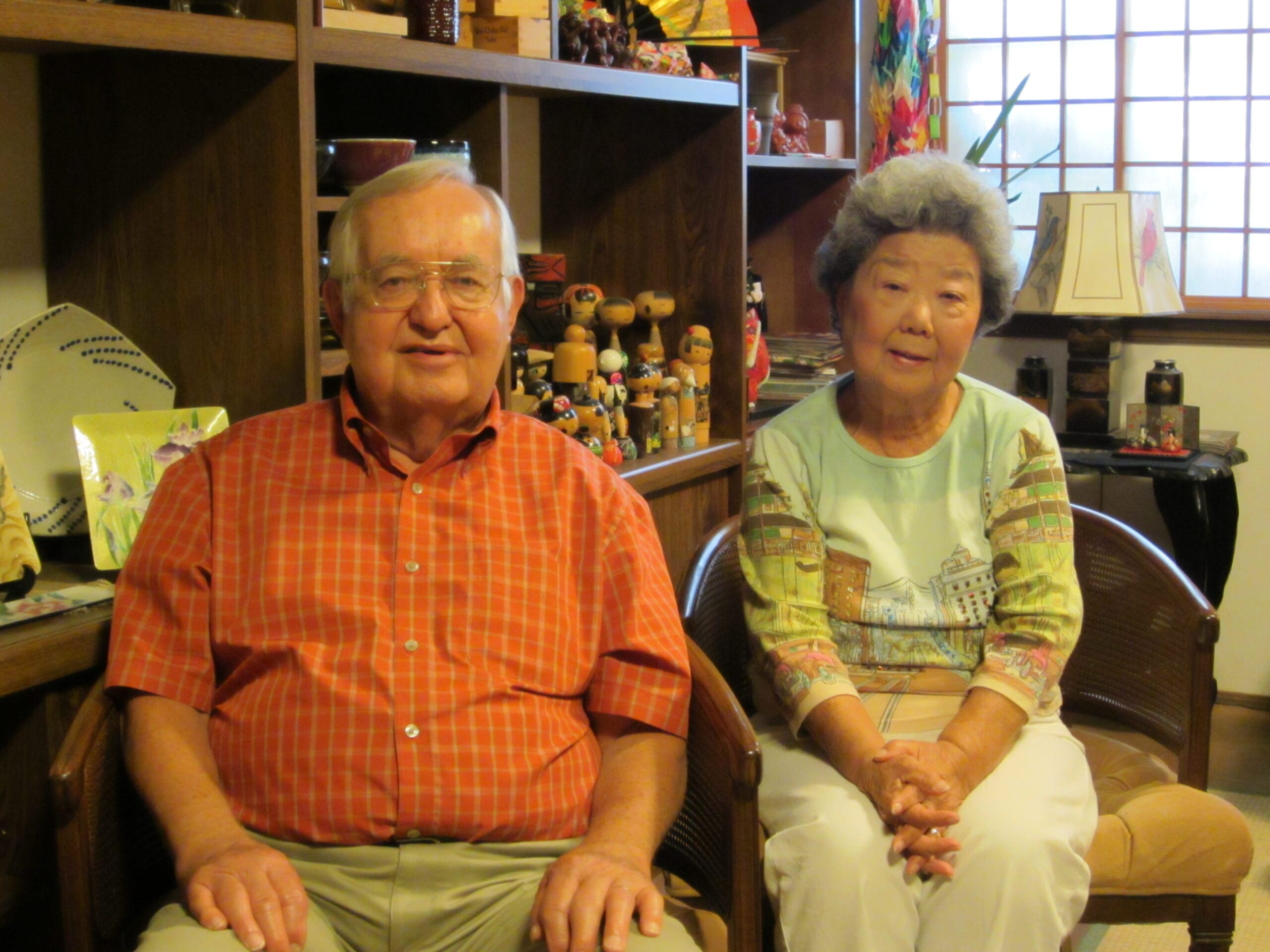
About This Interview:
Oral history interview with Larry and Kayo Jones, charter members of Stillwater’s Sister Cities Council, reflecting on 30 years of cultural exchange with Kameoka, Japan. Topics include the founding of OSU-K, Japanese gardens, trilateral exchanges, and citizen diplomacy.
About Larry and Kayo Jones:
In 2011, Larry was honored with the Japanese Minister of Foreign Affairs Commendation for his twenty-five-year commitment to the US-Japan relationship. In their interview, the Joneses discuss the development and growth of Sister Cities International in Stillwater, their work and travels for the cause, and the importance of American and Japanese students in its success.
Working from President Dwight Eisenhower’s inception of Sister Cities International, Oklahoma established a relationship with Kyoto Prefecture, Japan, in 1985. Eisenhower’s nonprofit organization was established for the purpose of creating and maintaining global connections, and since its origin, the relationships across the globe now number in the thousands. As a result of the Oklahoma-Japan connection in 1985, Stillwater became the sister city of Kameoka.
In November of 2015, these sister cities celebrated their thirty-year anniversary. Since the beginning of the Oklahoma-Japan relationship, Larry and Kayo Jones have been key players, and Larry was a charter member of the Sister Cities Council. The Joneses met and married in Japan when Larry was in the Armed Forces, and he quickly developed an appreciation for and interest in the customs and cultures of other countries, specifically Japan, Kayo’s homeland. After the military, Larry earned his bachelor’s degree from Oklahoma State University, eventually going back for his master’s and PhD. After working in New Mexico and California, he wound up back at OSU where he stayed for twenty years.
The couple have been to Kameoka several times, even living there for two years when Larry was the associate director of Kameoka’s OSU-K campus. In 2011, Larry was honored with the Japanese Minister of Foreign Affairs Commendation for his twenty-five-year commitment to the US-Japan relationship. In their interview, the Joneses discuss the development and growth of Sister Cities International in Stillwater, their work and travels for the cause, and the importance of American and Japanese students in its success.
In this interview, Larry and Kayo reflect on the enduring legacy of the Stillwater–Kameoka partnership and the human connections that have shaped its story.
Transcript of Oral History Interview with Larry and Kayo Jones (2015)
SOK Oral History Project
Interview of LARRY AND KAYO JONES
09/01/2015 – Stillwater, Oklahoma
BJ: Brandon Jones
LJ: Larry Jones
KJ: Kayo Jones
BJ: OK, my name is Brandon Neal Jones and today is the first of September 2015 and we are here in the home of Larry and Kayo Jones, to interview them for the Spotlighting Oklahoma, excuse me, Oral History Series of the Oklahoma Oral History Research Program. Today we will be discussing the Sister Cities International Relationship, going on 30 years now, between Stillwater, Oklahoma and Kameoka, Japan and the exemplary role that the Jones…Jones’s have fulfilled for their communities. Thank you for agreeing to participate in this research project. Um, I think the best place to start is right at the beginning, we can’t ever have enough history about, uh where this all began.
LJ: OK…
BJ: Mr. Jones…
LJ: Well it all began in 1985, spring of 1985 when the state of Oklahoma and Kyoto prefectureentered into a sister state relationship. Soon after that the relationship became a reality. Officials in the city of Kameoka went to, uh, prefectural offices in the capital city of Kyoto said that they would like to establish a sister city relationship with a city in Oklahoma and provided some information about their city. They said that, uh, they were about an hour by train from the capital; that there was a university in their city and that a significant part of their economy was agricultural-based and there was some other information, but those were the things that come to mind. The, uh, people in Oklahoma City looked at that and said that they thought that Stillwater would be a perfect fit. So they contacted the city hall in Stillwater and asked if there was an interest in forming that relationship. People there said “yes,” they would be very interested.
BJ: So that came from the state of Oklahoma?
LJ: Yes.
BJ: The request did, ok…
LJ: Uh, soon after that a delegation from Kameoka came to Stillwater to look at our city and in the fall of 1985 a delegation from Stillwater went to Kameoka, um, to continue to have that discussion, and while they were there, on November 3, 1985, signed the paperwork that established the sister city relationship. So that was, uh, the start of it.
BJ: That was between Mayor Calvin Anthony and Mayor…
LJ: Mayor Yoshihisa Taniguchi.
BJ: Mayor Yoshihisa Taniguchi.
LJ: Um, Kameoka has been in existence for centuries, no doubt, but as a incorporate city, it’s celebrating its sixtieth birthday this year, in November of this year. Um, it was incorporated in 1955, prior to that, there were, was the town of Kameoka, which was a small town and 15 small villages in the mountains around that town. The, uh, national government sort of forced them to, (laughs) establish the sister, er, I’m sorry, establish an incorporated larger city, since Kameoka was the largest of the fifteen towns and villages involved, it became the name of the large city.
BJ: OK…
LJ: At that time it had a population of about 30,000. Today its population is nearly 100,000, so it’s grown significantly in those 60 years. As you know, Brandon, the Hozu River runs through the center of Kameoka dividing the city. It has, uh, a lot of historical places. The remains of an old castle was built there to guard the northwest entrance to the city of Kameoka in, uh, the early 1600s, so it was there for a long time. There’s temples and shrines that go back more than a thousand years. Izumo shrine goes back to the early 700s; Anao-ji Temple to about that time, so there’s a lot of history associated with our sister city. So we’re very fortunate to have such a relationship.
BJ: Yeah, and let’s see here… So in 1985 we have 2 cities that we’ve got an agricultural connection, we’ve got the university connection, we’ve got a similar distance from the capital as a connection. Where did the, I guess… where did the, the… because from what I understand Sister Cities International is very much about citizen diplomacy, um, so where did that start to blossom? Where did the, the politics or the political side kind of stepped as… step out of it and where did the citizens, where did they really, when did that start to grow?
LJ: From very early on.
BJ: It did…
LJ: Some sister cities are established so that a city in this country, for instance formed a relationship with a city in, in Africa that is very poor.
BJ: OK.
LJ: And so it’s, uh, that sister city relationship is primarily established to benefit, to help the people in Africa.
BJ: OK.
LJ: They may need water, uh, many cities in this country with a relationship in Africa have gone and, and drilled water wells, or they’ve taken medical supplies or other things to help those cities uh, economically to help them.
BJ: Uh-huh.
LJ: Some of the larger city relationships, uh, for example Tulsa, has a very active economic relationship with some of its sister cities because they just have a lot more industry in their cities. Stillwater and Kameoka, we, neither of us are poor, neither of us are terribly affluent, but both are, you know, middle class kind of communities. So then from the very beginning we recognized that our primary relationship would involve one-on-one diplomacy, um, educational exchanges, art exchanges, these kind of things where we could, could both appreciate the culture and customs of the other.
BJ: And where, where did you get your start? Where did you and, and Kayo get your start with…
LJ: Oh, that was…
BJ: …with the sister cities?
LJ: OK, um, there was an article in the newspaper…
BJ: OK.
LJ: Just after the paperwork was signed in Kameoka, when that delegation returned they put an article in the newspaper, said we have established a sister city relation but city hall cannot do it by themselves, we need volunteers. Anyone that might be interested in being a part of that, um, they had a meeting at the old armory. Um, I attended that meeting and…made a few comments, Joe Weaver was there, made some comments and… when the, the meeting finished, um, I’m not sure that I can contribute significantly to this so I was prepared to leave and let them move ahead with their relationship. I can thank the former city manager Carl Winog that came up to me at the end of, of that and said, “We’re going to have a meeting at city hall, to establish a, a group, which, you know, became the sister cities council. Why don’t you attend that?” And I thought, “Well if he sees that I might contribute something, I’ll attend their meeting, at least.” Well, there were nine in attendance, including myself, we by the end of that meeting had formed a group which we called the Sister City Council, and so those nine people were the, the beginning of our sister cities program.
BJ: Now, uh, some of those people… that would have been Sylvia Duncan…
LJ: She was…
BJ: You and uh, are there any others that are currently still on the…
LJ: Nah.
BJ: Just the two of you…
LJ: We’re the only two that were there at that initial meeting.
BJ: …at the initial meeting, OK. And Cindy Petree was an early member, but not…
LJ: Not…
BJ: Not at that original…
LJ: Not at that original meeting. We call them charter members.
KJ: From school. After school, sister school.
BJ: And, um, now, maybe we should back up even just a little bit further, because you have, obviously you have a connection with Japan prior to the Sister Cities Council, so…
LJ: And that connection is why I went to that first meeting…
BJ: Is why you went…let’s talk about that a little bit so that we understand, kind of, you know, how that developed. How did you two meet? Uh, you told me a little bit about it. It was at Otsu.
KJ: Yes, I was working at the [Camp Otsu], uh, military base.
BJ: Okay.
KJ: And the… Japanese employee, he work there, um, of course they have to have payroll/accounting. I was part-time payroll/accounting there. And before payday come I used to work there. And I meet him there. Not only him, but, you know, a lot of people there.
LJ: At Camp Otsu, there was, was two, it was divided into two bases, posts…
BJ: OK.
LJ: She worked at what was called A-Camp. I worked at B-Camp. In communications, Signal Corps. When she would finish in the afternoon, she would go out and catch a bus or a train back to Kyoto, to her parents’ home…
BJ: OK.
LJ: I would, on Camp A… A-Camp was the bigger camp, um, that’s where the PX and the theater and restaurant and the like was, so I would frequently go to A-Camp and go out to catch a bus back to B-Camp.
BJ: OK.
LJ: And I saw her and she caught my eye, and so began to talk and I found out where she worked and, fairly often, I would, uh, have to take radio teletype from where I was working to A-Camp to someone there at A-Camp. And so I began to, sort of, make a habit of detouring through her building. (laughs) As this relationship grew…
BJ: What year is this?
LJ: 1956, ’57.
KJ: ’56, ’57.
BJ: 1956, 1957. OK, so this would have been… thirty years before the beginning of sister cities, and now we’re, we’re coming up on…
KJ: Before, yeah, yeah, that’s…
BJ: And now we’re coming up on 30 years after, OK. And, uh, so you all met there at the military base in Otsu?
KJ: Otsu, he want to go to Kyoto to see, um, garden, he love garden and shrine or temple…
LJ: The first time I asked her for a date…
KJ: Yes.
LJ: …my thinking was that we’d go to dinner and then go to a movie. She said, “Why don’t we go visit a garden?” And I thought, “Well, that’s really not, what I had…
KJ: You mentioned about garden.
LJ: …I don’t want to ruin this relationship,” and I said, “Sure, that’s fine,” and we went to Heian Shrine and I was just enamored with the beauty of the place and I have loved the Japanese gardens since then.
BJ: In Kyoto?
LJ: Yes.
KJ: Uh-huh.
BJ: Is that, now, is that the Gold, the Silver or neither?
LJ: Neither. It’s another, another of many, many, many there.
BJ: That’s another…. that’s another one, OK.
KJ: Another, old one, beside…
BJ: OK, I, there was many that we saw while we were there and it’s…
KJ: Ah, yeah.
BJ: …they’re gorgeous.
LJ: They say that you can visit something of significance, a temple, shrine, a garden, a museum, a castle, uh…
BJ: Uh-huh.
LJ: …every day for five years in Kyoto and never visit the same place twice. So there’s a lot to see in that historical city.
BJ: I would believe it. So, OK, that’s a previous connection that has grown and developed and we find in 1985, November 3rd, Mayor Anthony and Taniguchi signed a proclamation declaring the sister cities relationship. In that next year, we have that first Sister Cities Council and then what is…Let’s talk about, maybe, one of your, one of your first exchanges or one of your first, um, what was one of your first exciting memories, one of your first, you know, moments when you really realized, that, uh… ‘Cause, I mean, you’ve been a part of this for 30 years now, there had to have been a moment when you were, you know, “I’m going to enjoy this, I’m going to have fun.” What was that moment, or…?
LJ: Well it was (laughs) it was very, very early on, almost immediately…
BJ: OK.
LJ: The following year, the following November, a large delegation came from Kameoka to Stillwater to celebrate the first anniversary of our… sister cities relationship. Um, we were very, very involved in that… you know, didn’t know… how, how much we would be involved over the years at that time…
BJ: Uh-huh.
LJ: …but it’s continued from that time and during that time, Mayor Tani[guchi] – well the delegation visited OSU and were taken on a tour of the campus. One of the places they went was the English Language Institutes, ELI, and while there were there Mayor Taniguchi asked if it might be possible for OSU to establish an English language program in Kameoka. That conversation continued but it grew as the conversations continued and it eventually became a full-fledged campus, what later became known as… when it was established became known as OSU-Kyoto. Most people… It’s generally referred to as OSU-K and most people assume that stands forKameoka, but it actually stands for Kyoto to signify the, the significance that it’s a state university here and so they treat it as a prefectural university there…
Kayo’s been almost like a mother to a lot of the students.
Larry Jones
BJ: OK.
LJ: By designating it as OSU-Kyoto, or OSU-K. Um… early on, when I heard that was going to happen, I hoped with all (laughs)…
KJ: [indistinguishable He was hoping…?]
LJ: …my being that I might become a part of it. And became a part of it. And Kayo and I spent 2 years on the OSU-K campus, which is less than an hour from where she lived the first 22 years of her life, so it was a marvelous opportunity for both of us.
BJ: And you went over… now that, when did they establish OSU-K?
LJ: The conversation started in, you know…
BJ: Right away…
LJ: 1986 but it didn’t involve, evolve into a university until 1990. And, August, late August of 1990, a group of 153 students came from to Japan to Stillwater to study English. The model for the program was a five-year model. One year of English language instruction here in Stillwater and then they would return to Japan for the freshman and sophomore level general education classes, then return to Stillwater for the junior and senior level classes in the major area of their choice.
BJ: And you were there for 2 years, um…
LJ: Yes.
BJ: …with that program? Now, you’ve also been writing the Kameoka…
KJ: …Korner.
BJ: …Korner for the Stillwater News Press…
KJ: Uh-huh…
LJ: I have.
BJ: …um, how, how long have you been working on that project? Has that been going on since…?
KJ: …twenty-five…
LJ: Oh, for… more than twenty years.
BJ: OK.
LJ: I wrote articles, very short articles, prior to going to Kameoka in 1990. I did that for a couple years and then started again in 1994 and have done it continuously since 1994.
BJ: And Kayo…
KJ: Yes.
BJ: What is, how have you… how do you find yourself being involved in this project?
KJ: This one, I am doing, I’m not sister city council…
BJ: Uh-huh.
KJ: …but I am helping sister school middle school, to go translate, uh…
LJ: (coughs)
KJ: Mr. Mills? You know John Mills?
BJ: Uh-huh.
KJ: He used to be a principal there.
BJ: OK.
KJ: And [of course] and we have three boys, too. Two of them in middle school. I mean, two of them. Not middle school. They are Mr. Mill’s care.
BJ: With Mr. Mills.
KJ: Yes, he’s a council, uh, Sister City Council. And, you know, I do all the kids get from there to here. They get homesick that age. So they call me, “Kayo what’s wrong with, you know, this kid, up temperature,” most times it’s general if you rest and drink a lot of water I bring to here to rest and sleep and two three hour they are new people. And it sounds like OK, so I call the school and like, she’s all right, and the delegation from there and they’re helping food need to be take care of so most time, Larry and I go to city help too but most time I am doing behind and the dinner.
BJ: You’re working the behind-the-scenes and making that wonderful sukiyaki dinner…
KJ: Oh, did you get…
BJ: Yes, I got to eat…
KJ: Oh, well that’s too many, two or three people…
LJ: Kayo’s been almost like a mother to a lot of the students…
KJ: Yes, I have some parents say, “Thank you for taking care of my daughter or son,” and uh, you know, just writing for Japanese students so I hung up there and I went to school there how they do here in America so I go to the, uh, to the tell them…
BJ: So you, you provide a little bit of a home-away-from-home?
KJ: Yes, I’m volunteer, strictly volunteer. I still doing for the college student OSU and uh, they are short time to stay, but its sad day always because they are leaving quickly. But I invite them at least once to American home, you know, because the Japanese are so small, [something about small]… so, anyway, I just want to do not only Japanese student, I have, I have, some Chinese, Korean, lots of… you know, they speak different, but we speak one English.
BJ: Yeah, so we have a pretty healthy exchange program here in Stillwater?
KJ: Uh-huh.
BJ: With uh, is it middle school only, or…?
KJ: Middle school only, we only one middle school here…
LJ: Primary…
KJ: Oh, they’re primary…
LJ: Primary middle school. From time-to-time there’ll be a, a wings of rotary state student from Japan at the high school.
BJ: OK.
LJ: There’s an exchange student there this year, um…
BJ: Oh. I did get to meet him briefly at the…
LJ: At the… pizza party the other night.
BJ: Uh-huh.
LJ: And when those…
KJ: People are wonderful, I mean, you know… When you try to help. They are… they know, they didn’t tell me thank you no, but later on “oh that is Mrs. Jones, even OSU-K student, from Japan, father of OSU, not OSU-K because long ago he was here. Their son came to OSU-K, and the entrance we have Kyoto, is that right?
LJ: Uh-huh.
KJ: And he, man, looks like grey hair, I am grey too, but he was more white hair…
LJ: Uh-huh.
KJ: …He keep looking at me, so… I just look down I thinking, “But I don’t know him,” but when I looking up he’s still looking. After finish he come to hurry to get me, so I move away to go to home. So anyway, “Are you Kayo Jones?” “Yes, who are you?” I say. “I used… I am Mr. Kitogawa, I used to be OSU student, I come to you house, you prepare Japanese food, I never forget.” He said, “This time, my son, this one is going to be OSU-K, so when he come will you take care of him?” “I sure will,” At least once, everybody been here, most people. So…
BJ: Well that is, that’s very nice, and… And you wouldn’t have stories like that…
KJ: It is, it’s a wonderful feeling, um, when he first though, I don’t know if I can do or not. Of course he help, too. And I have, we have 3 boys but they never complain. Always somebody here. But our boys are maybe going to put us that way to raise them. But they, they never complain. He doesn’t complain, but he doesn’t have to do cooking. But anyway…
LJ: A lot of students have come and with the Japanese food that they can eat, with a Japanese host, with a Japanese room, they say, “I really feel comfortable in your home. Please invite me back. And we…”
KJ: Some want to come back, and come back…
LJ: That first year, the 153 students that were here for a year… Virtually every one of them had a meal in our home, and through the years… you know, at the pizza party there were about 12 students…
BJ: Uh-huh.
LJ: …OSU students from Japan, she already has all their names and phone numbers…
KJ: I did but they write, they written down in Japan their phone number.
LJ: And they’re gonna be here. (laughs)
KJ: I don’t mean to [in home] so I can call them, how can I contact so I talked to Stephanie to, would you please write telephone number, each kid so I can…
BJ: For the U.S.?
KJ: That’s right, so…
BJ: What… let me take a quick look here… so… We have that first delegation that came, the large delegation that came to celebrate the one year anniversary. And then… did we do a five year anniversary?
LJ: We did.
KJ: Uh-huh.
LJ: Delegation from there came here and delegation from here went there.
BJ: And was that the tri-lateral or was that later?
LJ: No…
BJ: That…
LJ: …that was later.
BJ: That was later…
LJ: That was after the fifth anniversary.
BJ: That was after, OK.
LJ: Between the fifth and tenth, I don’t remember the exact time.
KJ: and we went 10 years, too.
LJ: Yes.
BJ: Why don’t you tell me a little bit about that fifth anniversary or did you go to Kameoka on that one?
LJ: Yes.
BJ: OK.
LJ: We went for the fifth anniversary; we went for the tenth anniversary…
BJ: Let’s…
LJ: …for the fifteenth anniversary…
I said to them, the thing that has impressed me most about my stay in Japan these two years is, is the kindness that I’ll observe. Not the kindness shown to me, you know, as a foreign tourist I expected to be treated very well. What I’m speaking of is the kindness you show one to another each and every day.
Larry Jones
BJ: Let’s talk about….
LJ: …if there’s a delegation going (laughs)…
BJ: You’re there, OK.
LJ: …we try to go.
BJ: There was something that Sylvia mentioned, she mentioned a wedding, there was a, um, kōen? Am I pronouncing that correctly?
KJ: Wedding, whose wedding?
BJ: No, no, no, no, not kōen, that’s the garden… ryokan that they, that you all would stay at ryokan that had a beautiful white wedding kimono in the lobby? Does this ring a bell at all, let’s see….
KJ: When we went there? Sylvia went there once, didn’t she?
BJ: I’m not sure which time this was and I’m not sure which… Let’s see… She made the comment though about how the ryokan owner, how he was letting them try on this, this gorgeous white wedding kimono that they probably should not have been wearing.
LJ: OK, um… there was a couple in Kameoka that had a company that made the silk brocade that was used to make…
KJ: That’s right… a silk company…
LJ: …wedding kimonos. I remember that most of the women tried one of those on…
BJ: Tried those on, OK…
LJ: …and that was in Kameoka.
BJ: Well, tell me about, tell me about your trips over there with the delegations. Just kind of, you know, what did you experience, what did you enjoy?
LJ: Oh, it was wonderful treatment. We’re able to experience their customs and their culture and their kindness…enjoyed the beauty of the old city. Just every one of the visits we’ve made to Kameoka’s been special. We’ve visited the elementary school… several times had meals in the elementary schools the children would set and, you know, try [kick under the conversation], just so many wonderful experiences. The two years that we spent in Kameoka with the OSU-K program. Near the end of that, the rotary club, the president of the rotary club asked if I would speak to their rotary club about our experiences in Kameoka in the two years that we were there, and perhaps the only thing that’s worthy of remembering. (laughs) I said to them, the thing that has impressed me most about my stay in Japan these two years is, is the kindness that I’ll observe. Not the kindness shown to me, you know, as a foreign tourist I expected to be treated very well. What I’m speaking of is the kindness you show one to another each and every day. Their vocabulary is structured such that as they speak to one another, it’s in a very kind and thoughtful way. I’ve just always been amazed at their kindness to one another as well as to foreign tourists visiting their country.
BJ: And how was your time over there Kayo, did you enjoy being close to family?
KJ: Well, that… In Japan is my birthplace in Kyoto. And then sure, every time I go home, I let my mother know first. And mother call my classmate, you know. It’s [something] would you give her call at this number that’s her number. Anyway, um, this is the OSU-K I was working there at the library for students, but classmates have reunion, you know, classmate all junior high, high school classmate. And they calling each other, “Kayo coming,” so I did see only my address is American way, 319 North Donaldson, but all the other is Japanese, likely for the Japanese got married to the Japanese. Of course all the boys were saying, “Why don’t you come home?” You know, “Well, I have a son, three boys, and grandchildren there, that and my husband’s there; I have to be there, you know, I like to be there.” But it’s nice to come home. They are so home, they’re just, I haven’t seen them long time. And hugging each other, that’s where I learned hugging strange people, I mean it’s not strange but classmate long ago, but they, they hug me too, and they, “Welcome home,” and, “Stay longer,” you know, and…
BJ: So you all were able to get together for those two years that you were there at OSU?
KJ: I, I call my mother for…
LJ: Sometimes, when we’ve gone back… Now the Japanese are amazingly good at networking, they… you know, what she’s talking about goes back fifty years to when she was in elementary and junior high school and they still are in contact… Most of them still live very close to where they’re born.
KJ: Yeah, but lot of people have passed…
LJ: It’s amazing, they get together. When they find out she’s coming they plan a get-together and have a meal. The fellowship there is pretty amazing.
KJ: Yes.
BJ: And when you were over there, what was your… What was your position with OSU-K? What were you doing over there?
LJ: I was the associate director and I taught physics.
BJ: You were teaching physics and the associate director? And did I catch you were working at the…
KJ: At the library, I was there. And, and did you go to Kameoka?
BJ: I did get there but I did not get to OSU-K.
KJ: Oh, you didn’t, that’s where his office was and I was working at Old Central…
LJ: Old Central.
KJ: Just like OSU…
BJ: The copy of Old Central?
KJ: That building I was there, book, you know library there, and…
LJ: It’s an amazing likeness.
KJ: It’s beautiful.
BJ: I have seen some photos of it, but I did not get to see it myself, uh and I regret that.
KJ: You must went to there to ask them, “I’m from Stillwater,” you know?
BJ: Uh, it…
KJ: They like to have Stillwater people.
BJ: Well, I’ll tell you more about that in just a little bit.
KJ: OK.
BJ: Um, trying to think… So we’ve got, this is 1992, about, that you’re coming back to the U.S.?
KJ: ’93.
LJ: From ’91 to ’93.
BJ: So then you would be coming up on the tenth anniversary, then, of the sister city shortly thereafter that. Did we have a delegation come here; did you go back to Kameoka?
KJ: They came, too.
LJ: Both, they had delegation, delegation from here went there. And we were a part of it.
BJ: And what, did you have some… What were some of the, the main activities involved with that? A ten year anniversary that was probably a pretty big celebration.
KJ: I have old picture in [something] I was going to show…
LJ: At that time… They had just completed a new city hall, shortly before.
BJ: Stillwater or Kameoka?
KJ: Kameoka.
LJ: Kameoka.
KJ: Beautiful building there.
LJ: The, uh, it’s no doubt the envy of every city in Kyoto prefecture, a beautiful nine or ten story city hall, that, when it was completed was completely payed for, debt free. So they manage their funds extremely well, it’s very, very impressive. Um, every time we go we’d ride the Hozu rapids. That’s been a while; I don’t remember all the exact things we did at that exact time…
KJ: They have bigger reception…
BJ: Would that have been the time… when did they bring over the materials for the garden?
KJ: The garden.
LJ: Soon after…
BJ: Was that about that time?
LJ: 1996, or ‘7.
BJ: OK.
KJ: Yeah.
BJ: So that was right after the tenth anniversary. And do you want to tell me a little bit about, uh, what they did? Because that was quite, quite a gift from Kameoka.
LJ: It was indeed. Um, yes, they… The first time I went, we went to Kameoka after the sister city relationship was formed was in 1987. Kayo and I and the McKinnleys, who were friends visiting Japan, went to Kameoka and, um… Something was said about, um, Japanese gardens and I said I like them a lot. They rounded up one of the staff members at city hall. We sat down and talked about Japanese gardens and he said… he gave me a set of plans, says take them back toStillwater in case there’s anyone interested, if the city’s interested in building a garden. Well, we talked about that every time we had a monthly meeting. My contribution was, “Let’s build a garden.” That didn’t happen. But then, when we went in 1995, for the tenth anniversary, they said there is a group of Japanese landscape artists here that are discussing the possibility of building a garden in Japan… I’m sorry, in Stillwater, um, you will be hearing from them. Not too long after we returned we heard from them. They intended to do that in the summer, I’m sure it was 1996. A small group of the gardeners came and we looked at several sites in Stillwater as possible sites for the garden, um, the site that’s north of the community center where the garden is, was actually the second choice but it has worked out very, very well.
BJ: Uh-huh.
LJ: They made arrangements to rent heavy equipment or machinery to um… that would be needed in the construction and a big crane and a Bobcat and other equipment. Um, we went to Oklahoma City and they… we went to a rock place, they picked out some rocks. They said, “We would like to use these rocks at a smaller garden at OSU at the, at the botanical garden.” Uh, I spoke to the manager, the owner of the rock… collection, whatever it’s called, told him what, that they would like to buy there rocks but they wouldn’t be back until September. I thought he would say, “Well you come back in September and we’ll talk about this.” He said, “We’ll set them aside and whenever you’re ready for them, come pick them up.” We went to a nursery on North Perkins Road which was there at that time. They picked out over $5,000 worth of plants, trees, topsoil, fertilizer, said, “We want you to set this aside and we’ll be back in September.” I thought they would respond the same. They said, “We’ll set them aside, when you’re ready for them, come and get them.” We called a company in, in, Ponca City about a, a big crane that they would need to move heavy rocks and lanterns. Um, they just would set it aside for you, said, “You don’t just get the crane, we won’t rent the crane without an operator.” So I told… we told them what day we wanted them to bring the crane. Before they came, they shipped over twenty tons of material from Japan, payed for entirely by the city of Kameoka, volunteer gifts from citizens of Kameoka, donated money and the gardeners donated their money and time. They said, “We will be there on a certain day and there are two shipping containers that will arrive the morning of that day.” You’re putting a lot of confidence in this shipment. The morning they said they would be there those two shipping containers showed up. The crane showed up with the operator. It was just amazing. Those gardeners all came from Kameoka and on a daily basis they were competing for one another for business in Kameoka, but while they were here, they worked together like a well-oiled machine.
BJ: Huh.
LJ: I mean, every morning they would meet, and each would be assigned their responsibility for that day. That heavy crane operator worked with one of the gardeners, they didn’t speak the same language, but that crane operator would set those big stones exactly where that gardener told him. It was just an amazing thing to watch…
BJ: Those boulders… those were, those were sourced out of the Hozu River, correct?
LJ: It’s… from that area, yes.
BJ: And let’s see…
LJ: And during the two weeks that they were constructing, the people of Stillwater almost a steady stream of cars coming by, honking and waving and stopping, thanking them for what they were doing.
KJ: They were happy, and they can’t speak, you know, but everybody was waving.
LJ: School… school children would come and bring cookies, school classes would come and and ask, “You know, tell us what you’re doing.” One man who had fought during the Second World War came by and said, “I have not liked the Japanese since the Second World War, but seeing what these guys are doing, I have to put that behind me and move on,” said, uh, “I’ve brought 30 tickets for the OSU football game on Saturday, and I’d like to give them to them and whoever’s going to take them to the game as my way of saying, ‘Hey, I… I’ve accepted you as being really good people.’” So it just, touched the lives of a lot of people in Stillwater.
BJ: Well it sounds like it and it sounds like…
KJ: You know, people are change, you know, like this man, of course, during the war, course he went to the war. My family, too, my uncle, too, never come back. So… I was a little girl, so I, you know… It hurt me when you come to someone say something like, “I don’t buy a Japanese product,” or something like that. Or hurt me, but you have to listen to our side, too, but war is just need be part.
BJ: Well and it sounds like that, you know, that idea of citizen diplomacy, that that is very much alive and well within this, this organization and…
KJ: Now I love to stay here, I love to stay; I love people, Stillwater people. I don’t know everybody but most people, “Are you Kayo?” “Yes,” Well, you know, sometimes he mention in Kameoka corner, so, I have, uh, student…
BJ: So where, let’s see, probably the late ’90s is what we’re about up to here… Let me think… Oh, what point…Let’s see… So, uh, Mayor Tanaguchi and, and Mayor Calvin Anthony, those were the two that were kind of at the beginning of this, but we’ve had several mayors, we have had several mayors since, now Kameoka has, Taniguchi has been the mayor up until pretty recent, right?
KJ: Yes, I think…
LJ: There have been four mayors involved…
BJ: OK.
LJ: …Two mayors…
KJ: Two mayors…
LJ: Mayor Tanaguchi followed by Mayor Tanaka followed by Mayor Kuriyama, so there’s only been three, there will be a forth in November.
BJ: Who was the third?
LJ: Kuriyama.
BJ: Kuriyama…
KJ: Kuriyama…
LJ: He’s just about to finish and doesn’t plan to run for re-election.
BJ: And is it… Did I hear correctly that the fourth, the mayor that is coming up, he was one of the gardeners that installed…
KJ: That’s right, that’s right. I’m very happy about that. Because he’s uh…
LJ: Mayor…
KJ: Katsuragawa, his name.
LJ: Mayor Katsuragawa.
KJ: Yeah, he flew here the most, I will tell you, I mean. When he’s…
LJ: Spell it just like it sounds.
KJ: He’s a… very, very nice person.
BJ: Make sure… oh, um, tell me about some of the annual activities that you all do here in Stillwater. Um, I know that you all, we, uh talked about the sukiyaki dinner that I got to join in on that was, that was excellent. But tell me about some of just the local events that the Still… that the Stillwater Sister Cities Council hosts.
LJ: Oh, through the years we, uh, you know, we have the monthly meetings where we discuss… activities that we need to be involved, what’s going on in Kameoka, if there’s any exchanges coming up, what we might do to strengthen our relationship, you know, whatever we need to talk about…
BJ: Uh-huh.
LJ: You know, you mentioned the Sukiyaki dinner; we’ve done that annually for several years. Um… in recent years we’ve done the pizza party which we had at, at Hideaway last week. Prior to that, for a number of years we did an ice cream social at the Wes Watkins Center for the, uh, the Japanese students, most of whom were at the ELI at that time, so it was very convenient for them, but in recent years we’ve done the pizza party instead. Um… a few years ago we did a hay ride at a farm south of town. Stephanie…actually, Stephanie and her husband own the property. Went down and did the hay ride and a wiener roast, had a really nice time…
BJ: Yeah, um… it seems like a lot of the activities the Sister Cities Council does is with students coming to OSU from Japan or students coming to the high school or the junior high or middle school. Now you all… would you say that a focus is on the students or is that just…
LJ: A lot of the activities are focused on the students, yes.
BJ: OK, OK…
LJ: And we have a potluck dinner every Christmas…
KJ: Uh-huh.
LJ: …and we’ve done that for a number of years.
BJ: And does the Sister Cities Council, do you all work with the exchange program with junior high, or actually, I know. Because we have the sister schools and we have the Sister Cities Council, are those completely separate programs…
LJ: No.
BJ: …or do you all very much work together, and, and…
KJ: together…
LJ: Very much work together.
BJ: OK.
LJ: Yes, and the sister schools began, came about because the sister city relationship.
BJ: OK, OK.
KJ: That’s quite, very long, sister school was.
BJ: And about how long has that been running?
LJ: I think it started in 1989, so it was…
BJ: Oh, it was almost…
KJ: ’89?
LJ: Yes. No later than ’89, I know. Yes.
KJ: It… Well… ’89 it started… We would be in Kameoka, to [NO CLUE, bamboo fields?]
LJ: That was after. [?]
KJ: But the students come…
LJ: 1990 there was a large group of students that went to Kameoka.
KJ: 1990, oh they, I was there.
LJ: Yes. Because of the sister school relationship.
BJ: And… What else would you like to just tell me about… about the history and about you two, you, you and Kayo, about your involvement in Sister Cities Council and also where you kind of like to see it go? You know, you’ve been a part of the past 30 years, where would you like to see it go into the future? Do you have any, um… any hopes or expectations for its….
LJ: There’s…
KJ: I know where he want to go.
(laughter)
LJ: There’s been a number of adult delegations go to Kameoka, and it’s a wonderful experience, I’ve been part of a number of them. And it’s a wonderful experience and you make good friends and you come back re-energized to work harder in the program et cetera. But when students go, particularly the ones that have gone from here have been middle school students, when they go, it can be a life changing experience. It’s not something that they come back and say, “Hey, I really had fun,” and that’s the end of it. It has changed a number of lives in a very, very significant ways.
KJ: Even the college students, they have a good experience to take home to their other students, you know? So they may come back and they did come back to OSU…
BJ: Have you seen a kind of word of mouth, uh, as far as you know, somebody comes to OSU or comes to the Stillwater Public Schools and then later on you find out, you know, that they’ve sent their younger sibling or they’ve sent a friend of theirs or, you know, eh, are you seeing that sort of…
LJ: Some of that, you know the one that…
KJ: Father, father and son…
LJ: The father sometimes, too, son came. Uh, in 19-…well, it must have been around 2000, maybe 2005, the mayor, no, city commissioner, Bud Lacy, he later became the mayor, but was city commissioner at that time, he went as part of a delegation and took his son, who was… sophomore, junior in high school and never been out of the country, um… he enjoyed it a great deal. The next summer, he says, “Dad, let’s you and I go back to Japan by ourselves.” And they did. Had a wonderful time. Today that son lives in Japan, has been there for at least five years, probably more than five years and is likely to continue to live there for maybe a very long time. He just loves it…
KJ: His mother wants him to come home, “Time to come home,” call a while ago, “But mom, I like Japan.” So he’s still there, still.
Uh, we’d made arrangements with a number of families in Stillwater, the group was around 30 so we needed several host families to be their homestay families. Several of them called, said, “We’re not going to be able to do it because we’ve lost our power.” Tree limbs down, power lines down, I thought, “Oh, this is going to be an absolute disaster, these people have come all this way in this kind of weather, no one’s going to show up.”
Larry Jones
BJ: How old would you say he was on that first trip?
LJ: Oh, probably 15.
BJ: 15, OK…
KJ: Yeah, he was a little boy. Now he’s a grown man.
BJ: So an adolescent and, and now, that, that trip changed his life.
KJ: That’s right.
LJ: There were several. An OSU-K student from Oklahoma City, Jason Good, that…
KJ: Jason Good, yes, he lives in Japan.
LJ: …Studied on the OSU-K campus for about a year, came back to OSU and graduated, went back to Kameoka. He still lives in Kameoka and that was in the early ’90s. He still lives in Kameoka, is married to a Japanese girl…
KJ: They have a little boy.
LJ: He has bought a business recently and is doing very, very well. And those kind of things are not unusual.
BJ: Let’s see here… Let’s see, 2005, that’d be the thirtieth anniversary… no, I’m sorry…
KJ: No… Twenty…
BJ: …That’ve been twentieth anniversary. Uh, 2010 would have been our twenty-fifth anniversary which, I believe is when the ocarina players came?
LJ: They came earlier than that.
BJ: Was it earlier than that?
KJ: Uh-huh.
LJ: They came in 2001.
BJ: Oh, so it’s way earlier…
LJ: Quite a bit earlier, yes.
BJ: Could you tell me about that? Because it sounded like that was quite an event.
LJ: It was. If I were to list the three… favorite… programs or activities that the sister city program has had… been involved in, um, one of them would be the ocarina group, one of them would be the garden and one would be OSU-K. Um, the ocarina group came on a very cold and icy January day…
KJ: It was…
LJ …in 2001. Not long after they arrived in Stillwater that evening, they closed Interstate 35 out from about 51 almost to Oklahoma City because of, because of the ice.
BJ: Uh-huh.
LJ: Uh, we’d made arrangements with a number of families in Stillwater, the group was around 30 so we needed several host families to be their homestay families. Several of them called, said, “We’re not going to be able to do it because we’ve lost our power.” Tree limbs down, power lines down, I thought, “Oh, this is going to be an absolute disaster, these people have come all this way in this kind of weather, no one’s going to show up.” Well, when the performance started that evening at the, in the auditorium in the Wes Watkins Center, seats about 400 and there were very nearly 400 there, it was just amazing. They played a little instrument called an ocarina which is a small, about six inch clay flute. And the one that each person used, they made themselves, from clay that was excavated when they started building the foundation for what’s called the Gallery of Kameoka, in, in Kameoka, a large convention center. Made those, came, performed for a full house on that cold, windy evening…and it was just really a wonderful event.
BJ: That sounds like that would have been…
KJ: Did you know ocarina?
BJ: I, I saw a…
KJ: At the Kameoka room?
BJ: Yes, in the Kameoka room…
KJ: That we donated because they brought us… I had a lot of homestay.
BJ: OK.
LJ: I have one right in there.
BJ: But no, I saw the one that was in the Kameoka room…
KJ: Yes.
BJ: …and, um…and Silvia explained a little bit about…but I wasn’t sure if that was from the, the clay that was from Kameoka…
KJ: Uh-huh.
BJ: …or if that was just another ocarina, but that is, that’s one that was created…
KJ: Yep. That clay.
LJ: Correct.
BJ: …from that clay.
KJ: And they made it, you know? That they-
BJ: Well… are there any other… I’m sure, I, I know we’re probably missing things here but…oh, actually, there is one more thing that I wanted to be sure and ask you about, and that was… your commendation by, let me make sure I get this right… uh, being honored by the Foreign Ministry of Japan. Why don’t you tell us…?
LJ: We received that award in 2011 and it’s a commendation that has my name on it. But Kayo has been from the very beginning very, very involved in all this. The commendation was given because of our involvement with the, the Japanese students here in Stillwater, as well as in Japan. You know, I think probably that was initiated by someone in Kameoka probably at that time.
BJ: What was the name of that award?
LJ: Just Foreign Minister’s Commendation.
KJ: We have one in living room. We framed it…
BJ: In your living room, ok. We’ll get a picture of that before we head out. And that was, was that conferred here or was that over in Japan?
LJ: It was here…
KJ: Here, at OSU we had about 300 people attending.
LJ: The Consul General stationed in Houston came to Stillwater to present it personally, so it was…
BJ: I bet that was a very…
LJ: Very nice honor.
BJ: Yeah. And uh, please, are there any other things that you two would like to…
LJ: Well, you asked what we envision or hope for the future…
BJ: Yes.
LJ: Uh, one of those I was talking about the, the impact on children’s lives’. But we haven’t had a, a youth exchange in recent years. We’re going to Kameoka in November. I hope to be able to talk to someone in the educational system there…
BJ: Uh-huh.
LJ: A super intendant of schools or whoever, about the possibility of getting something up and going again that would allow students to… to go from Stillwater to Kameoka or Kameoka to Stillwater, cause it… you know, it impacts the students from Stillwater’s lives; it also impacts the life of students from Kameoka…
BJ: Yeah.
LJ: …in the same way. So, you know, that… I don’t think we can do anything better than impact the lives of young people. So that’s… that would be my main goal.
BJ: Would you like to add…
KJ: Yes…
BJ: …anything to that Kayo?
KJ: Well, I hope… I… You know I’ve been doing this for thirty years… and I just had a surgery, and, you know, my strength is… not like used to. I can’t help very much. But when the day come, I will help, you know. Translate or whatever they need. I been helping city… or, try to do… whether they need school or hospital or you know, general…
LJ: And you never know when… you help someone, when that’s going to go full circle and come back to you.
BJ: Yeah…
LJ: At some point in this relationship, there was a girl in Oklahoma City that needed some help. I don’t even remember what kind of help they needed, what Kayo did for her…
KJ: They call from Oklahoma City Governor’s office…
LJ: We were, uh… at the airport in Osaka, checking through customs, or immigrations to board our plane. Someone had given us a gift, a tiny little sword, part of a samurai set about like so in that box and one of the immigration people said, “You’re going to have to open that box and let us look at that.” There was a girl working with him, said to her, said “Aren’t you Kayo Jones?”
KJ: Because my passport, they open it, yes, so I sat there. I’m not supposed to bring those things, but gift, so I just…
LJ: …she said, “Yes.” The girl said, “You’re good to go.” She said, “You helped me in Oklahoma City, I’ll return that favor right now.”
KJ: She, I help her long ago, she…I don’t even remember…
LJ: We don’t even know when it was.
KJ: …but she told me, “You help me, when I, in program, you know.” I didn’t remember, “So you don’t have to open, just go.” So that’s nice to hear.
BJ: To know that you’ve been able to touch people…
KJ: Yeah.
BJ: …and to also, to have been touched by so many people.
LJ: That’s right.
KJ: That’s right, I think so. Yeah.
BJ: Well, I think this has been a wonderful interview; I thank you both for taking the time to do this with me…
KJ: Uh-huh.
LJ: You’re very welcome, thank you for doing so.
BJ: …I’m looking forward to the thirtieth anniversary celebration that’s coming up October twenty-fifth, um, and if there’s any last little thing that you would like to say to the camera…
(laughter)
BJ: But otherwise…
LJ: We’re honored to be a part of this, so thank you for coming and talking with us.
KJ: Yes.
BJ: Thank you. And thank you for showing me this room, this is…
KJ: Ah, thank you.
BJ: …this is wonderful.
LJ: It’s a pretty amazing place.
KJ: Would you like some tea, or something?
BJ: I am good, I’m gonna, let me shut this all down, this will take me just a moment and before you all move I’m going to take a photograph of you all, um, I have to…
——————————END OF INTERVIEW——————————
To learn more about Sister Cities initiatives around the world click here.